Every time Marketing proposes a new SKU—a seasonal variety pack, a club-store pallet display, or a limited-time flavor—Operations faces a binary choice.
Do we build the capacity internally (CapEx)? Or do we outsource it to a contract packager (OpEx)?
For years, the default instinct in manufacturing was “ownership is cheaper.” If you own the machine, you don’t pay a supplier’s margin.
But, with raw material volatility and 98% OTIF (On-Time In-Full) requirements, that logic often fails. Owning an asset that sits idle for six months a year destroys margins faster than paying a co-packer’s fee.
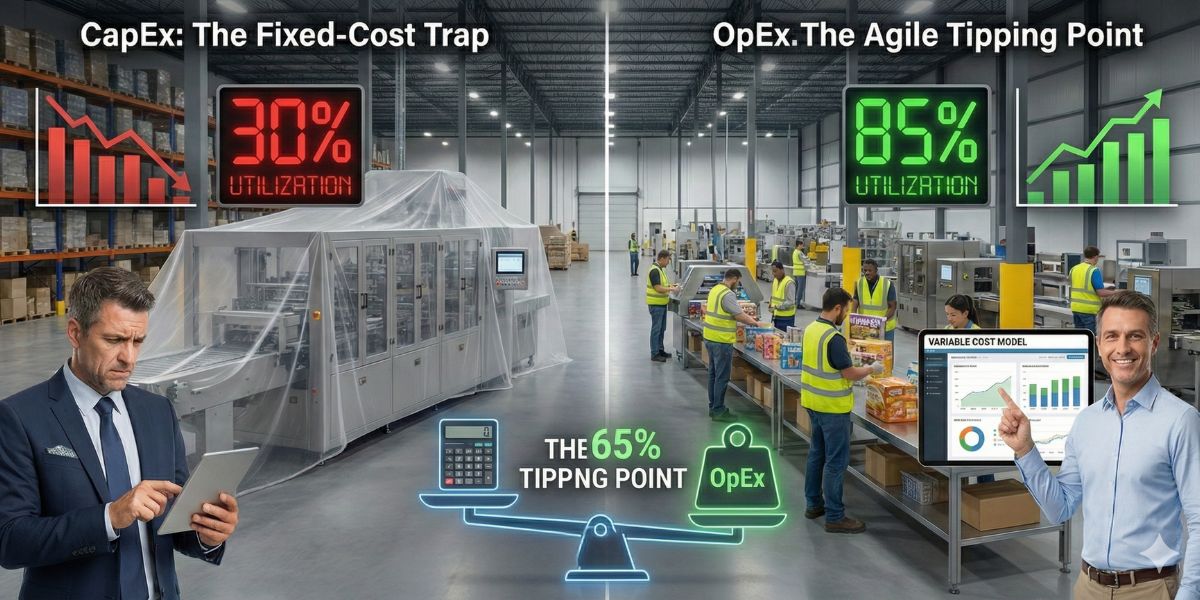
So, where is the line? We use a framework called The 65% Utilization Rule to help CPG leaders calculate the tipping point.
The 65% Utilization Rule
To justify a Capital Expenditure (buying a line), you generally need a projected Annual Asset Utilization of 65% or higher.
How to calculate it:
(Total Projected Run Hours / Total Available Shift Hours) x 100
If the result is under 65%, the “Total Cost of Ownership”—including depreciation, maintenance, floor space, insurance, and labor training—will likely exceed the per-unit cost of a co-packer.
Scenario A: The ‘Core’ SKU (Buy It)
- Product: Your standard 12-pack, sold year-round at every retailer.
- Projected Utilization: 85% (Running 2 shifts, 5 days/week).
- Verdict: Insource. This is a high-volume, low-volatility product. Buying a dedicated, high-speed line drives the cost-per-case down to pennies.
Scenario B: The ‘Volatile’ SKU (Outsource It)
- Product: A “Holiday Mix” variety pack or a new product launch with untested demand.
- Projected Utilization: 30% (Heavy running in Q3 for Q4 delivery, idle in Q1/Q2).
- Verdict: Outsource. If you spend $500,000 on a line that sits silent for eight months, your effective cost-per-case skyrockets. By using a co-packer, you pay a slightly higher “toll fee” per unit, but you carry zero fixed cost when demand stops.
The ‘Changeover’ Factor
Beyond utilization, you must calculate the Operational Drag of the new SKU.
Internal manufacturing lines thrive on monotony. They are designed to run one format fast.
Co-packers thrive on complexity. They are designed to change formats frequent.
If bringing a new variety pack in-house requires your high-speed line to shut down for 4 hours every Friday to retool, you are not just paying for the new SKU—you are losing production time on your profitable core SKUs.
The Tipping Point: If a new SKU requires more than 15% downtime for changeovers, it belongs at a co-packer, regardless of volume.
Strategic Agility
The smartest CPGs today use a Hybrid Model.
They aggressively automate their core volume internally (CapEx) to maximize margin. But they ruthlessly outsource their seasonal, promotional, and volatile volume (OpEx) to maintain agility.
Don’t let a “Fixed Cost” mindset trap your cash flow.
Review your asset list. If you have machines running at 40% utilization, you are paying a premium to own your own headaches. Korpack’s Co-Packing Division helps brands convert those fixed costs into variable growth.
Connect with us to know more.