
Under the new Extended Producer Responsibility (EPR) laws active in 2026, not all packaging is created equal.
While the base fees cover the cost of recycling, the real financial lever is “Eco-Modulation.”
This is the mechanism states use to penalize “bad” design and reward “good” design. For Food & Beverage manufacturers, understanding these variables is the difference between paying a flat tax and paying a penalty surcharge.
Here is how Eco-Modulation actually works and the specific design choices that trigger higher fees.
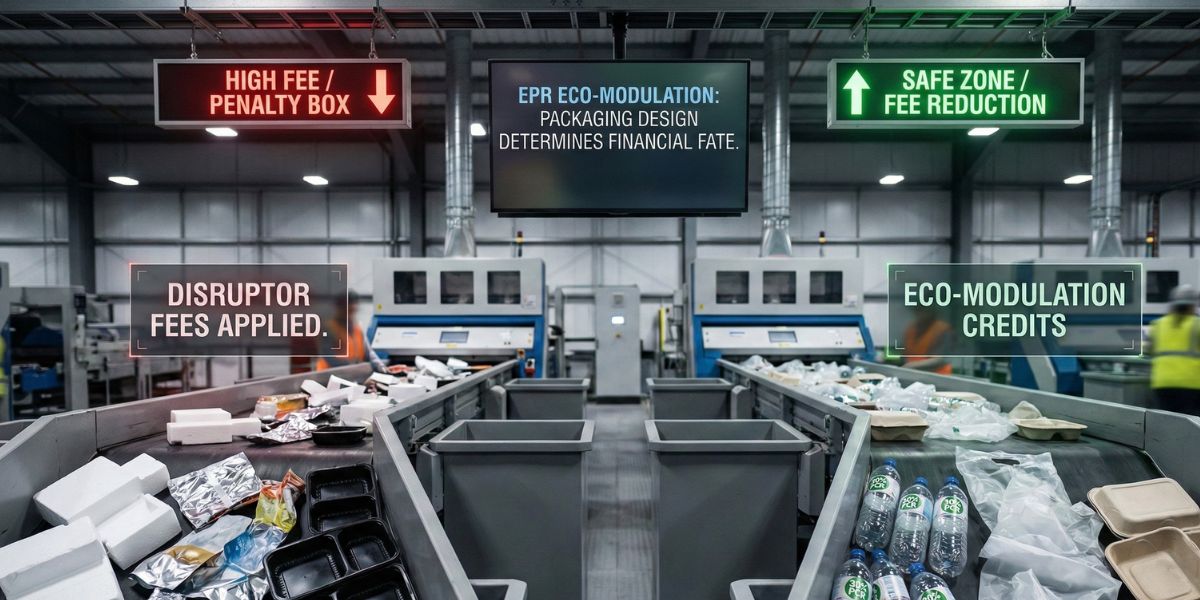
The Penalty Box: High-Fee Materials
If your packaging relies on these materials, you are likely paying the highest tier of PRO fees right now.
- Expanded Polystyrene (EPS) / Foam
- The Issue: Difficult to recycle; contaminates waste streams.
- The Fee Impact: Most states apply a “Disruptor Fee” or a high base rate. Colorado and California are targeting this material aggressively.
- Multi-Layer Flexible Films
- The Issue: Pouches that mix plastic and aluminum (or different resin types) cannot be separated in standard MRFs.
- The Fee Impact: Classified as “Non-Recyclable,” triggering the highest fee tier.
- Toxic Additives (PFAS, Heavy Metals)
- The Issue: “Intentionally Added Toxics” are a major focus, especially in Maine.
- The Fee Impact: Maine applies a significantly higher fee (potentially 10% surcharge) for any packaging containing these substances.
- Carbon Black Plastics
- The Issue: Near-Infrared (NIR) sorters in recycling facilities cannot “see” black plastic, so it ends up in the landfill.
- The Fee Impact: Often treated as non-recyclable residue.
The Safe Zone: Fee-Reduction Strategies
You can lower your EPR liability by engineering your packaging to meet specific “Eco-Modulation” incentives.
- Monomaterials
- The Strategy: Switch multi-layer pouches to single-resin structures (e.g., all-PE).
- The Benefit: Qualifies as “Recyclable,” moving you to a lower fee tier.
- Post-Consumer Recycled (PCR) Content
- The Strategy: Incorporate 30% or more PCR into your rigid plastics (PET, HDPE).
- The Benefit: Direct fee discount. States like California and Washington mandate this, but exceeding the minimums often yields financial credits.
- Label Compatibility
- The Strategy: Ensure your labels wash off easily and use compatible adhesives (e.g., APR Design Guide approved).
- The Benefit: Avoids the “Contaminant” penalty that applies when a label renders the underlying bottle unrecyclable.
The Tipping Point: Internal vs. Outsourced Compliance
For many brands, the cost of re-engineering packaging to avoid these fees is high.
This is where the “Make vs. Buy” decision shifts.
- Internal: You pay the R&D cost to redesign the package + the capital cost to upgrade the line to run the new material.
- Outsourced (Co-Packing): You utilize a partner who already runs compliant, monomaterial lines. You pay a variable fee, but you avoid the capital risk and potentially lower your EPR liability if the co-packer holds the “Producer” status for certain private label agreements (check your specific state definitions).
Next Steps
Review your Bill of Materials (BOM) today.
If you see “EPS,” “Multi-Layer,” or “Carbon Black,” you are paying a premium.
Korpack’s engineering team can audit your material mix and calculate the projected fee savings of switching to eco-modulated alternatives.