
If you sell through Amazon and you have not updated your packaging specs in the last 12 months, you are probably losing money right now.
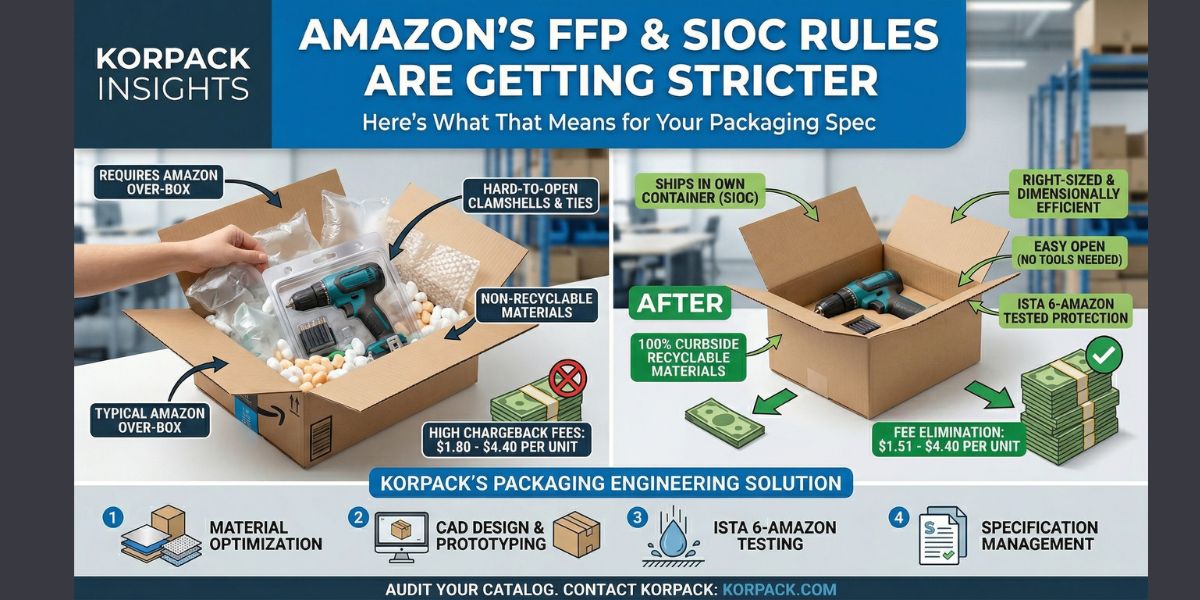
As of January 15, 2026, Amazon began charging new packaging fees for small bulky and large bulky products that are not enrolled in its Ships in Product Packaging (SIPP) program—the rebrand of what most people still know as Frustration-Free Packaging (FFP) and Ships in Own Container (SIOC). These fees range from $1.51 to $4.40 per unit, depending on shipping weight. On top of that, Amazon ended its FBA prep services on January 1, 2026, meaning sellers and vendors are now fully responsible for packaging compliance before products ever reach a fulfillment center.
For brands moving thousands of units a month through Amazon, those per-unit charges add up fast. And the fix is not complicated—it is a packaging spec problem, not a business model problem.
What Changed and Why It Matters Now
Amazon has been tightening its packaging requirements for years, but 2026 marks the sharpest escalation yet. Here is what the current landscape looks like:
- Any product with packaging dimensions exceeding 18” x 14” x 8” or weighing over 20 lbs must be SIPP-certified. Products that qualify but are not certified face chargebacks of $1.80 to $4.40 per unit.
- New packaging fees averaging $2.07 per unit now apply to bulky products that require Amazon to add over-boxing or additional packaging materials.
- Amazon’s FBA prep services are gone. Brands must ensure products arrive at fulfillment centers already packaged to SIPP standards—or absorb the cost consequences.
- The program now has three certification tiers: Prep-Free Packaging, Ships in Product Packaging, and Frustration-Free Packaging (the highest tier). Each has different requirements for box strength, ease of opening, and material sustainability.
The practical takeaway: if your product can ship without an Amazon over-box, it should. And the packaging has to be engineered to prove it.
The Packaging Spec Challenge
SIPP certification is not just about shrinking your box. Amazon’s requirements are specific and technical:
- The product must survive Amazon’s ISTA 6-Amazon.com transport simulation testing without damage—meaning the packaging itself must provide all the protection, with no outer shipping box.
- Packaging must be easy to open without tools (for FFP tier). No wire ties, no clamshells, no excessive taping.
- Materials should be curbside recyclable. Amazon is pushing toward 100% recyclable packaging across the program.
- Dimensional accuracy matters. Right-sized packaging reduces void fill and lowers dimensional weight charges—the two largest drivers of avoidable fulfillment cost.
For brands with dozens or hundreds of SKUs on Amazon, this translates to a significant packaging re-engineering effort. Every product needs its box re-evaluated: Is the corrugated strong enough to ship without an over-box? Is the interior protective packaging adequate? Are the dimensions optimized for Amazon’s dimensional weight pricing? Are the materials compliant with recyclability requirements?
Get it right, and you save $1.50 to $4.40 on every unit, permanently. Get it wrong, and those chargebacks compound every month you wait.
Where Most Brands Get Stuck
The challenge is not awareness—most brands selling on Amazon know about FFP and SIOC. The challenge is execution.
- Packaging was originally designed for retail shelf or pallet shipment, not for surviving Amazon’s fulfillment network as a standalone shipper. Retrofitting is harder than designing it right from the start.
- Multiple SKUs mean multiple packaging specs. A brand with 50 Amazon-eligible products needs 50 packaging evaluations, 50 potential redesigns, and 50 sets of ISTA testing.
- Internal packaging teams are often stretched thin. The engineering work required to optimize every SKU for SIPP competes with new product launches, seasonal campaigns, and day-to-day operations.
- Corrugated and protective packaging specs need to be precise—strong enough to protect without over-boxing, but not over-engineered to the point of adding unnecessary cost and dimensional weight.
This is the gap where brands either absorb mounting chargebacks or invest in getting the packaging right.
How Korpack Solves This
This is packaging engineering at its core—and it is exactly what Korpack was built to do.
Our packaging engineers evaluate every product holistically: corrugated strength, interior protective packaging, dimensional optimization, and material selection. We do not just resize a box. We engineer a package that passes ISTA 6-Amazon testing, meets SIPP certification requirements, and minimizes your dimensional weight charges—all in one coordinated effort.
Here is what that looks like in practice:
- Material selection and optimization — We work across corrugated, chipboard partitions, custom foam, air pillows, bubble-on-demand, and molded pulp to find the right protection at the right cost, without over-engineering.
- CAD design, prototyping, and spec sheets — Every redesign includes CAD files, 3D renderings, and pallet configuration drawings. For rapid iteration, our QuicKOR® on-demand box-making system can produce custom-sized prototypes without cutting dies—so you can test and refine before committing to full production.
- Specification and artwork management — We manage the spec changes and artwork revisions across your entire Amazon catalog, so your internal team does not have to.
- Single-source coordination — Because we supply corrugated, interior protective packaging, labels, and poly film, the entire SIPP-compliant package comes from one partner. No coordination headaches across multiple vendors.
And because we hold inventory through our VMI program—nearly 200,000 square feet of warehouse space in the Chicagoland area—your Amazon-ready packaging is warehoused and available for just-in-time delivery. No more scrambling when Amazon volumes spike.
The Bottom Line
Amazon’s packaging fees are not temporary. They are structural, and they will continue to tighten. Every month your products ship through Amazon in non-compliant packaging, you are paying a premium that a packaging spec update could eliminate.
The brands that treat this as a packaging engineering project—not just a compliance checkbox—will come out ahead on cost, fulfillment speed, and customer experience. The ones that keep absorbing chargebacks will keep paying for packaging twice: once for the box, and once for the penalty.
Paying Amazon packaging chargebacks you shouldn’t be?
Korpack’s packaging engineers can audit your Amazon catalog and build SIPP-compliant specs that eliminate per-unit fees.