
Consumer Packaged Goods (CPG) companies are under more pressure than ever to move faster. In 2025, major retailers like Walmart and Target ratcheted up On-Time In-Full (OTIF) delivery standards to nearly 98%, penalizing delays with fines of about 3% of COGS (Cost of Goods Sold). At the same time, raw material prices swung unpredictably and consumers clamored for more variety packs and club-size offerings. The result is a margin squeeze where every day of delay or idle capacity hurts the bottom line. Yet many CPG firms still bleed cash by treating packaging as a fixed asset instead of a flexible service. In this high-speed market, the cost of being slow is steep – but the cost of chasing speed with the wrong approach can be even higher.
2025 Packaging Trends: Faster Cycles, More SKUs, Higher Volatility
By 2025, the CPG packaging landscape had evolved dramatically. Companies faced a whirlwind of SKU churn and demand volatility. Shorter product life cycles and hyper-targeted SKUs became the norm. In practice, this meant far more frequent product launches (and discontinuations) to keep up with fickle consumer trends. In fact, after years of rampant SKU proliferation, many brands began focusing on “portfolio health” – actively pruning low performers and rationalizing SKUs. This underscores just how intense the churn has been: product lines are in constant flux.
One clear trend was a shift toward shorter production runs and seasonal variants. In 2025, CPG manufacturers rolled out more limited-time flavors, retailer-exclusive multipacks, and small-batch trial products than ever before. Every season brought a new configuration or package size, and demand could spike or fizzle overnight. The drive for speed-to-market and a steady stream of “fresh” offerings turned agility from a luxury into a necessity. Simply put, being late to shelf means lost sales. As one industry commentary put it, the competitive edge boils down to a simple question: can you help a brand launch a new product 20–30% faster without compromising quality? Speed, adaptability, and flexibility have become survival skills in this environment.
This volatility isn’t just anecdotal – it’s hitting balance sheets. Supply chain disruptions and sudden demand shifts cost the CPG sector billions in lost margins each year. The cost of rigidity is high: companies bogged down by inflexible packaging setups face months-long lead times to retool, while agile competitors can execute new packaging in days. In today’s market, the slowest mover loses – whether through missed trends, retailer chargebacks, or inventory write-offs.
What Is OpEx-Based Co‑Packing?
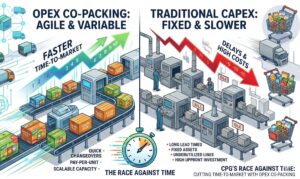
Enter OpEx-based co-packing – a model designed for agility. “OpEx” means treating a cost as an operational expense (variable cost) rather than a one-time capital investment. In packaging, this translates to contract packing services that you pay per unit or per run, instead of buying your own packaging lines. In effect, co-packing converts a fixed asset cost into a variable, pay-as-you-go service.
Consider the traditional approach: When marketing proposes a new SKU or seasonal variety pack, operations often default to “buy and build.” They purchase new case packers, install conveyors, and hire staff. This is CapEx-heavy and slow – and it can be a costly mistake if the product’s demand is uncertain. For instance, one CPG manufacturer invested $450,000 in a semi-automated line (plus four operators) for a holiday pack, only to use that machine for 14 weeks of peak season. The other 38 weeks of the year it sat idle, depreciating at 100% speed while producing nothing. When they crunched the numbers, the fully burdened cost per case exceeded the product’s retail margin. In short, they spent capital and floor space on an asset that became a cost anchor.
OpEx-based co-packing offers a faster, leaner alternative. Instead of months-long capital projects, a co-packer can be brought online quickly to handle the new SKU. You pay a “toll fee” per unit packed, and if the product is a flop or purely seasonal, your costs drop to zero when demand stops. There’s no idle equipment draining ROI. Industry benchmarks suggest a useful rule of thumb: if a new packaging line won’t be utilized at least ~65% of the time, it’s likely cheaper (and wiser) to outsource that volume to a co-packer. The math is simple – below about 65% projected utilization, the total cost of ownership (maintenance, labor, depreciation, etc.) will outweigh a co-packer’s fees.
Agility is another big advantage. Internal lines thrive on long, steady runs of a single format; they hate frequent changeovers. Co-packers, by contrast, thrive on complexity – their operations are built to handle quick changeovers and multiple package formats back-to-back. If bringing a new SKU in-house would force your main line to shut down for hours each week to swap tooling, that new SKU is effectively taxing your core business. A good guideline: if a new product introduction would consume more than 15% of an internal line’s time in changeovers, it belongs at a co-packer, no matter the volume. Why sacrifice core production throughput and incur overtime just to accommodate a volatile SKU? An OpEx co-packing approach avoids that trade-off entirely.
Speed and Flexibility Through Co‑Packing
Co-packing isn’t just about outsourcing work – it’s about buying speed and flexibility. Leading contract packers have invested heavily in capabilities that directly support faster time-to-market. This includes modular production lines, digital quick-changeover technology, and cross-trained teams ready to pivot on short notice. In 2025, as CPG manufacturers demanded ever-shorter runs and more last-minute promotions, co-packers responded by installing quick-changeover machinery and building capacity for surge volumes. The entire supply chain had to get faster: packaging suppliers started offering rapid prototyping and shorter lead times to keep up. The message is clear – if you can’t help brands compress their launch timelines, you’ll be left behind.
Operational agility has truly become the new mantra. Brands expect their external packaging partners to adapt on a dime. For example, if a sudden TikTok trend spikes demand for a flavor, or a retailer requests a special promo pack last-minute, a co-packer should be able to surge output or accommodate a packaging tweak without breaking stride. This means offering smaller minimum runs (to pilot new concepts) and holding surge capacity in reserve for peak season spikes. Mid-sized CPGs, in particular, want assurance they won’t be sidelined when bigger clients ramp up orders. The co-packers winning business in 2025–2026 are those who guarantee predictable access to capacity and rapid changeovers for all their clients – big or small.
The ability to hit the market fast has a very real payoff. Capturing a seasonal opportunity or beating a competitor to shelf can mean a significant revenue win. As one industry expert noted, the optionality that comes with agile co-packing – the ability to seize a market opportunity at just the right moment – is often worth far more than any per-unit cost savings you’d get by running everything in-house. In other words, speed and flexibility generate ROI. A brand burdened by rigid, fully utilized assets simply cannot respond quickly to a 30% surge in orders or a last-second custom display request. But an agile brand with an automated co-packing partner can scale up or down in days, closing that “agility gap” and turning on a dime. In 2026’s market, that gap is often the difference between a sell-out success and a missed chance.
Crucially, co-packers also help protect quality and consistency even under rapid changes. Top firms invest in robust quality assurance and traceability systems so that moving fast doesn’t mean breaking things. Co-packers that can scale with speed and uphold strict quality (and sustainability) standards become strategic extensions of the brand team. This is a key point: external packaging partners are no longer judged only on cost – brands now look at how well a co-packer can help them innovate, ensure compliance, and stay resilient amid chaos.
Slashing Fixed Overhead with a Variable Cost Model
From a financial perspective, OpEx-based co-packing turns packaging into a variable cost aligned with your sales. If demand goes up, you pay for more units; if it goes down, you pay for fewer – and you aren’t stuck carrying the fixed overhead of underused equipment or full-time labor. This flexibility is gold in times of demand swings. For example, if a promotion underperforms, an internal line might sit idle (still incurring depreciation, leases, and minimum staffing), whereas with a co-packer your costs simply taper off in proportion to volume. On the flip side, if a product takes off unexpectedly, a co-packer can often absorb the spike by tapping additional shifts or capacity shared across multiple clients. You’re not scrambling to invest another million in machinery overnight – the co-packer has elastic capacity built into their business model.
Reducing fixed overhead is not just about machines; it’s also about labor and operations overhead. Think of the headaches that come with staffing an in-house packaging line for seasonal runs: recruiting and training temp workers, managing overtime, dealing with higher error rates from inexperienced staff, etc. These are very real costs, often hidden. Many CPGs find that when they outsource a promotional packing job, they are “buying a finished case, not the headache of staffing a third shift on a Friday night.” In other words, the co-packer takes on the complexity of labor management, training, safety, and turnover. The brand simply receives product ready to ship. This hidden labor tax of internal packing – the training churn, quality variance, and management drag – disappears from your ledger. Your full-time staff can focus on core production without distraction, improving efficiency all around.
Moreover, eliminating or deferring big capital expenditures in packaging frees up cash for strategic uses. It’s often said that idle steel is idle cash. Money tied up in a packaging line that’s running at 30–40% utilization is money not being used for marketing campaigns, new product R&D, or inventory of raw materials that could prevent stockouts. By embracing a variable cost model, CPG companies improve their cash flow and financial agility. They can invest in growth, rather than sinking capital into equipment that might collect dust in the off-season. This is why forward-thinking CPG leaders in 2026 are aggressively shifting more packaging operations from CapEx to OpEx – it protects the P&L by aligning costs with actual activity.
In practical terms, a hybrid packaging strategy often makes the most sense. High-volume, steady sellers (your core SKUs) run on optimized in-house lines for maximum efficiency. But volatile, seasonal, or experimental SKUs are handled through co-packing – turning would-be fixed costs into variable ones. This hybrid model means you automate and own what you reliably need, but outsource the rest to stay nimble. The key is not letting a fixed-cost mindset trap your organization. If you have packaging assets averaging 40%–50% utilization, you’re essentially paying a premium to “own your own headaches,” as Korpack’s experts put it. It’s far more cost-effective to convert that capacity to an on-demand service.
2026 Outlook: Labor Shortages and Sustainability Mandates
Speed and cost pressures aren’t happening in a vacuum – 2026 brings its own external challenges that amplify the need for agility. Labor constraints remain a thorn in the side of manufacturing and packaging operations. Unemployment is low and warehouse labor wages have been climbing, making it hard to staff manual packaging lines. Many regions face a chronic shortage of skilled packaging workers, and high turnover is an ever-present risk. In response, both brands and co-packers have accelerated investments in automation – from robotic case packers and palletizers to automated labeling and vision inspection systems. Automation isn’t just about efficiency; it’s about resilience when people are hard to find. An automated or semi-automated co-packing line can ensure consistent output even when the labor market is tight.
The right co-packing partner can help a brand effectively decouple capacity from labor market volatility. By 2026, it’s clear that packaging lines overly reliant on manual labor are vulnerable to wage inflation and staffing crunches. Whether you invest in internal automation or partner with an automated co-packer like Korpack, the goal is to safeguard your throughput from labor-related disruptions. Co-packers often operate in multiple shifts with cross-trained teams, and can shoulder the burden of recruiting and training. This means fewer frantic phone calls for your ops managers when volume spikes – the co-packer handles it. As a bonus, automated systems tend to produce more consistent quality and reduce waste, further lowering costs in the long run.
On the regulatory side, sustainability and EPR regulations are rewriting the packaging rulebook in 2026. Extended Producer Responsibility (EPR) laws in several states are starting to levy fees or require reporting on packaging materials. Brands are suddenly on the hook for the end-of-life impact of their packaging – and excessive or non-recyclable packaging now carries direct financial penalties. One immediate implication: too many distinct packaging formats (i.e. excessive SKU-specific packaging variants) can drive up your compliance burden and costs. Every extra SKU or packaging configuration might mean another line in an EPR report and more fees. As a result, SKU consolidation and smarter package design have become strategic priorities. Companies are actively reviewing portfolios to eliminate low-value SKUs and standardize materials, both to cut costs and to simplify compliance.
Co-packers can be valuable allies in this sustainability push. The best partners stay ahead of regulations, offering options like recyclable or mono-material packaging that help clients avoid EPR fees. In 2025, 83% of brand owners expected packaging costs to rise (thanks to material inflation and new regulations), yet nearly all of them remained committed to sustainability goals. Many CPGs are looking to their suppliers and co-packers for solutions – for example, finding a co-packer who can run packaging made from recycled content or who can help redesign a kit to eliminate a plastic tray can directly support a brand’s ESG targets. In short, agility now includes sustainability agility: the ability to adapt packaging quickly to meet new environmental rules. A full-service co-packer with packaging engineers on staff can help redesign or swap materials on the fly as regulations evolve, whereas an in-house line might be too rigid or specialized to handle a sudden material change.
The ROI of Agility: Faster Launches, Lower Capital, Higher Resilience
Speed-to-market isn’t just a slogan – it has concrete ROI implications. Launching a product even a few months earlier can capture incremental market share, seasonal revenue, or simply learn fast whether a concept will succeed or fail. Being able to pull the plug quickly on a failing SKU (without having sunk capital into dedicated equipment) is a financial win; being able to double down on a hot seller without scrambling for capacity is equally valuable. The opportunity cost of missing a trend or being out-of-stock is something no spreadsheet will show directly, but it hits the business hard. This is why savvy CPG executives place such high value on agility and optionality. As one report noted, an agile co-packing partnership lets brands close the gap with demand – measuring new packaging turnarounds in days rather than months – and “the ability to seize a market opportunity is often worth more than the marginal savings on a corrugated case.” In other words, the return on agility comes from revenues captured and losses avoided.
Partnering with a full-service co-packer like Korpack directly reduces both launch lag and capital expense for growing brands. Korpack’s model, for example, offers an integrated approach: their Engineering Division designs high-speed internal lines for your high-volume core products, while their Co-Packing Division handles seasonal surges, variety packs, and complex promotional assemblies. This means you can innovate and experiment without large upfront investments. Need to roll out a limited-edition pack for summer? Korpack can design the packaging, source the materials, and pack it for you – as an OpEx service – in a fraction of the time it would take to procure and install machinery in-house. If the product succeeds, they have capacity to scale up production; if it underperforms, you walk away with no sunk CapEx, just the cost of the units produced.
The launch speed gained by using a co-packer can be game-changing. Instead of waiting 6–12 months to justify and build a new packaging line, a brand can be on shelf in a matter of weeks with a co-packing partner. That 20–30% reduction in time-to-market is not just a timeline compression – it’s real money in the form of earlier sales and faster time to revenue. It also means a more responsive supply chain: you can align product launches with peak seasons or retailer resets precisely, rather than missing the window. Meanwhile, the capital savings are substantial. Every $500,000 machine you don’t buy is capital that stays free for other investments or to simply improve your balance sheet. Co-packing effectively lets you rent expertise and equipment by the hour. When you tally up the avoided costs – machinery, maintenance, extra inventory holding, overtime labor, compliance fines – the savings and risk reduction become clear.
Finally, agility through co-packing builds a more resilient operation. The past few years taught CPG leaders that volatility is the new normal, whether it’s sudden shifts in consumer demand, pandemic disruptions, or new regulations. A co-packing partnership is like a pressure release valve for your supply chain. It gives you options when you’re at capacity, a safety net when you face a surprise, and a sandbox to try new things without betting the farm. In the U.S. market, where every percentage point of margin matters and the cost of being late or wrong is severe, this kind of agility is arguably priceless. By reducing launch lag and avoiding hefty capital outlays, co-packing not only saves money – it positions your business to grow faster and more safely.
Bottom Line: The cost of speed doesn’t have to be crushing. By leveraging OpEx-based co-packing, CPG brands can move faster, spend smarter, and stay flexible. The ROI of agility comes in the form of protected margins, captured opportunities, and a supply chain that can bend without breaking. As the industry heads further into 2026, those who embrace a hybrid, agile model – blending in-house strengths with outsourced agility – will be the ones turning speed into a competitive advantage, not a cost. And with full-service partners like Korpack available to shoulder the complexity, reducing time-to-market has never been more achievable or more advantageous. In the race against time, an agile co-packer might just be the ace up your sleeve.