

Getting a product accepted by a major retailer feels like the finish line. It is closer to a new set of rules. Large retailers run detailed, enforced compliance programs that govern how a product must be packaged, labeled, cased, and palletized, and they do not enforce those rules with a conversation. A non-compliant shipment gets rejected at the dock or hit with a chargeback deducted straight from payment. For a brand entering retail, packaging stops being a design choice and becomes a compliance requirement with money attached.
The frustrating part is that most of these rules are knowable in advance, and most of the failures are avoidable. This is a plain-language guide to what large retailers actually enforce on packaging, why each requirement exists, and where brands most often get caught. It is written for the secondary packaging layer, the cases, labels, displays, and pallets, which is where compliance is won or lost.
Start With the Vendor Guide, Because It Is the Rulebook
Nearly every large retailer publishes a supplier or vendor compliance guide, and it is the single most important document in a retail launch. It specifies case dimensions, case-pack quantities, label placement and content, shelf-ready requirements, pallet configuration, and often sustainability preferences. The rules are not universal; they differ meaningfully from one retailer to the next, and a package built to one retailer’s guide can fail another’s. The most common root cause of a compliance failure is simple: the brand did not pull the current vendor guide and build to it before production.
The practical implication is that retail-ready packaging cannot be designed from a product photo or a generic template. It has to be engineered to the specific retailer’s current brief, and it usually has to be proven with a physical sample the retailer approves before a purchase order is confirmed. A sensible rule of thumb is to budget several weeks, often in the range of six to ten, to go from brief to an approved sample when designing a new retail format from scratch.
What “Retail-Ready” Actually Means
Retail-ready packaging, also called shelf-ready packaging, is secondary packaging designed so store staff can move product from the delivery truck to the shelf without unpacking and repacking individual units. That single idea, truck to shelf with minimal handling, drives most of the requirements, because the retailer’s goal is to cut the labor of stocking a shelf. Done well, retail-ready packaging can reduce that store labor substantially, which is exactly why retailers push it so hard.
The most widely used design framework, led by the largest mass retailer and adopted broadly, is a set of principles often called the Five Easies. A retail-ready case should be:
- Easy to identify: product details and barcodes visible from multiple angles, so staff can find the right SKU quickly in the back room.
- Easy to open: a clean tear or perforation that opens without a knife or box cutter, for speed and safety.
- Easy to shop: product presented so the shopper can see and take it easily once the case is on the shelf.
- Easy to replenish: the case fits the shelf slot and orients correctly, so restocking is fast and consistent.
- Easy to dispose: the emptied packaging is easy to break down and, increasingly, easy to recycle.
These are not stylistic preferences. Each maps to a labor or safety cost the retailer is trying to remove, and a case that fails one of them, a perforation that needs a blade, a facing that blocks the next product, slows the store and invites rejection.
The Requirements That Actually Get Enforced
Beneath the framework sit the specific, checkable requirements that a receiving dock and a compliance system measure. The recurring ones:
- Exact case-pack configuration. The number of units per case must match the retailer’s item file exactly. Order a 12-pack case and ship a 6-pack, and the shipment does not just look wrong, it fails an automated check. Case-pack mismatches are one of the most common and most avoidable violations.
- Correct barcodes and product identifiers. Retailers require properly registered UPCs and GTINs, and the physical product has to match the electronic records. A barcode that will not scan, or an identifier that does not match the item file, stops the product at receiving.
- Compliant carton labeling, built in, not stuck on. Case labels must carry the required content in the required place. A frequent failure is applying labels as after-the-fact stickers rather than building them into the carton, which is fragile and often non-compliant. Shipping-container barcodes that tie a case to its shipment record are commonly required and commonly missed.
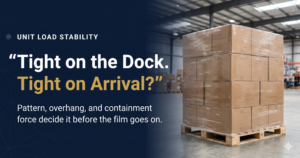
- Pallet configuration and load compliance. Pallet height, weight, overhang, and pattern have to meet the retailer’s specification so the load handles safely and fits the distribution network. A pallet that is too tall or unstable is a rejection or a fine.
- Date and traceability information. Code dates must be present and legible, and for food and beverage, traceability requirements are tightening, with major retailers pushing suppliers toward stricter case-level traceability ahead of regulatory deadlines.
The through-line is that these are binary, machine-checkable facts, not judgment calls. Either the case count matches or it does not. Either the barcode scans or it does not. That is what makes them enforceable, and it is also what makes them preventable.
Retailers back these rules with chargebacks, penalties deducted directly from what they pay you. The exact structures vary by retailer and change over time, but the scale is real. Large retailers commonly run two kinds of program at once: one that penalizes delivery timing and order completeness, and a separate one that penalizes packaging and labeling execution, such as barcode failures, labeling errors, and case-pack defects.
The two stack. A single shipment that arrives outside its window and has a labeling error can draw both. Reported figures put delivery-related penalties at a few percent of the cost of the non-compliant goods, and packaging-execution penalties at per-defect fees that can reach into the hundreds. Industry estimates of total deductions for a typical large-retailer supplier run into the mid-single-digit percentage of invoice value. For a brand on thin margins, that is the difference between a profitable retail program and an unprofitable one.
Channel Changes the Rules
Retail-ready is not one standard. The channel a brand is entering reshapes the requirements:
- National mass retail has the most codified rules: planogram compliance, exact case counts, mandated label placement, and shelf-ready secondary packaging as a baseline expectation, usually with a required sample before the purchase order.
- Club channels are among the most demanding, because product is displayed on the sales floor in its shipping packaging. The shipper is the display, which raises the bar on both structural strength and appearance, and club uses deeper bays and higher case counts than standard grocery.
- The major online marketplace enforces its own packaging programs for shipping in a product’s own container without an added overbox, measured against demanding transit-test standards. Notably, that marketplace stopped performing prep and labeling fixes for sellers in the United States in early 2026, which means a shipment now has to be right before it leaves the brand’s dock, because it will no longer be corrected downstream.
A single product often has to satisfy several of these at once, a mass-retail planogram, a club display, and a marketplace transit standard, which is why a brand scaling across channels cannot rely on one packaging format for all of them.
The Detail Almost Everyone Underestimates: The Tear
One small feature does a surprising amount of the compliance work: the perforation a store associate tears to convert a shipping case into a shelf display. It has to survive the whole trip closed, then open cleanly by hand in seconds. That balance is an engineering problem with a real specification behind it. The ratio of perforation cut to uncut material, sometimes discussed as a teeth-to-cut ratio in the range of three-to-one to four-to-one, decides the outcome. Too much cut and the case can burst in transit; too little and the associate cannot get a clean tear and rejects the case. It is a good example of how retail-ready compliance lives in details that look trivial and are not.
Sustainability Is Becoming a Requirement, Not a Preference
A newer shift worth planning for: sustainability criteria are moving from preference to gatekeeper. More retailers now expect recyclable, responsibly sourced secondary packaging, favor fiber-based cases over plastic and tape, and publish sustainability criteria in their vendor guides. For a brand designing a retail-ready format, choosing a recyclable, retailer-acceptable material from the start is easier than being forced to redesign later, and it lines up with the broader regulatory direction on recyclability and materials.
How Korpack Helps
Retail-ready compliance is an engineering and execution problem: the packaging has to be designed to a specific retailer’s current requirements, proven with a sample, and then produced consistently at volume. That is squarely what an engineering-led packaging and contract packaging partner does.
Practically, that means engineering shelf-ready cases, trays, and displays to a retailer’s vendor-guide requirements, including the structural details like clean-tearing perforations, then prototyping and sampling so a design is approved before production rather than rejected after. It means getting the case-pack configuration, carton labeling, barcodes, date coding, and pallet configuration right, because those are the binary checks that trigger chargebacks. And it means performing the retail-specific pack-out at volume, variety and club packs, retail-ready cases, relabeling with version control, kitting, and display builds, in certified facilities, so what ships matches what the retailer’s system expects. Accredited packaging engineers can also steer material choices toward the recyclable, retailer-acceptable options that increasingly show up in vendor guides.
One boundary worth stating: Korpack engineers and produces the packaging and performs the secondary packaging and pack-out. It does not fill or manufacture the product, and delivery-timing performance to the retailer remains part of a brand’s wider logistics. What Korpack removes is the packaging-and-pack-out half of compliance, which is where a large share of avoidable chargebacks originate. It is also the overflow capacity a brand can add when a retail win outruns its existing pack-out.
A retailer will not negotiate your packaging with you. It will measure it. Retail-ready packaging is about getting the measurable things right before the shipment leaves the dock.
Korpack engineers retail-ready packaging to your retailer’s actual requirements, case pack, labeling, pallet, and shelf-ready structure, and produces the pack-out to match. Let’s pressure-test your packaging against the vendor guide before the dock does.
855.567.7225 | korpack.com
Frequently Asked Questions
What is retail-ready or shelf-ready packaging?
Retail-ready packaging, also called shelf-ready packaging, is secondary packaging designed so store staff can move product from the delivery truck straight to the shelf without unpacking and repacking individual units. The case is built to be easy to identify, open, shop, replenish, and dispose of. The retailer’s goal is to cut the labor of stocking shelves, which is why large retailers increasingly require it and enforce specific design and labeling rules around it.
Why do retailers charge suppliers for non-compliant packaging?
Because non-compliant packaging creates cost and delay in their supply chain, and they recover that through chargebacks, penalties deducted directly from supplier payment. Large retailers typically run one program covering delivery timing and order completeness and a separate program covering packaging and labeling execution, such as case-pack errors, barcode and label failures, and pallet non-compliance. The two can stack on a single shipment, and total deductions can reach a meaningful percentage of invoice value, so packaging compliance has a direct effect on a retail program’s profitability.
What are the most common packaging compliance failures?
The most common avoidable ones are case-pack mismatches, shipping a different unit count than the retailer’s item file specifies, barcode and product-identifier errors that fail to scan or match records, labeling applied as stickers rather than built into the carton, missing shipping-container barcodes, and pallet configuration that violates height, weight, or stability rules. These are binary, machine-checkable failures, which makes them enforceable but also preventable by building to the retailer’s vendor guide and proving the design with an approved sample first.
How early should we start on retail-ready packaging?
As early as possible, ideally the moment a retail conversation looks real. Retailers usually require an approved physical sample before confirming a purchase order, and designing a new retail-ready format to a specific vendor guide, prototyping it, and getting it approved commonly takes several weeks, often in the range of six to ten. Starting late is how brands end up either missing a retail window or shipping a non-compliant package that draws chargebacks. Pulling the current vendor guide and engineering to it up front is the single highest-value step.
- Retail-ready and shelf-ready packaging references, 2026 (including SPS Commerce supplier-requirements guides, iPackU and Cosource shelf-ready guides, Packaging Studio retail-ready requirements, and Zenpack retail-ready guide). Source for retail-ready/shelf-ready packaging as truck-to-shelf secondary packaging, the Five Easies framework led by the largest mass retailer, the store-labor reduction driving adoption, First-Time Quality and the eight compliance areas (GS1 UPCs and GTINs, exact case-pack match, compliant carton labeling, pallet configuration), labels built into cartons rather than applied as stickers, the six-to-ten-week brief-to-approved-sample timeline, and the perforation teeth-to-cut ratio of roughly three-to-one to four-to-one.
- Retailer chargeback and vendor-compliance references, 2026 (including Industrial Packaging co-packer chargeback analysis, ShipCalm and Distribution Alternatives Walmart compliance guides, RetailerHub chargeback guide, and Weber Logistics chargeback overview). Source for retailers enforcing packaging rules via chargebacks deducted from payment, parallel programs for delivery timing (On-Time In-Full) and packaging/labeling execution (Supplier Quality Excellence), penalties stacking on one shipment, delivery penalties reported around a few percent of cost of goods and packaging-execution fees in the hundreds per defect, average supplier deductions in the mid-single-digit percentage of invoice value, and common triggers (case-pack mismatch, UPC/GTIN errors, missing shipping-container labels, pallet non-compliance, ASN mismatch).
- Channel-specific and marketplace references, 2026 (including retailer shelf-ready requirement guides and marketplace fulfillment-program coverage). Source for club channels displaying product in shipping packaging and being among the most demanding, national mass retail having the most codified planogram and case-count rules, the major online marketplace’s own-container shipping programs measured against demanding transit standards, that marketplace discontinuing seller prep and labeling services in the United States in early 2026, and sustainability criteria moving from preference toward a vendor-guide requirement.
- Korpack Marketing Guidelines and Value Propositions, November 2023. Source for Korpack’s corrugated packaging, packaging design and prototyping, pallet configuration drawings, contract packaging and co-packing (tray and case packing, club, variety, and combo pack-outs, point-of-purchase display builds, labeling, kitting), certifications, material selection, and packaging engineering. Korpack engineers and produces packaging and performs secondary packaging and pack-out of pre-manufactured product; it does not fill or manufacture the product.
Korpack is a technologically advanced packaging materials, contract packaging, and automation supplier that approaches solutions with an engineering mindset and creative flexibility. Founded by a packaging engineer, Korpack serves growth-oriented brands entering and expanding in retail across North America from its Chicagoland headquarters. This article is provided for general information; retailer requirements vary by retailer and change over time, so confirm the current vendor guide for the retailers you sell into.