

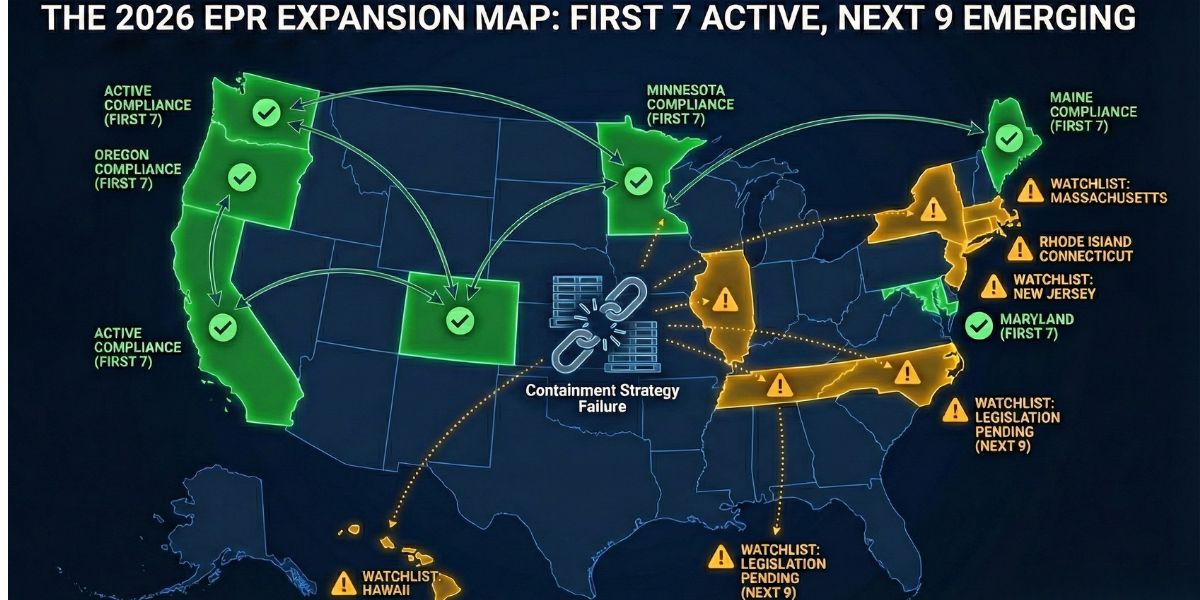
As of February 2026, the first wave of Extended Producer Responsibility (EPR) is officially live. The checks have cleared for producer dues in Colorado, data reporting is active in California, and teams are scrambling for the May registration deadline in Maine.
For many Food & Beverage manufacturers, the strategy so far has been containment: “We will isolate compliance to the specific states that require it and run standard packaging everywhere else.”
Market intelligence suggests this containment strategy is about to expire.
While your regulatory team focuses on the active laws in the “First 7” (CA, CO, ME, MD, MN, OR, WA), legislative data shows a massive second wave forming. This “Next 9” will likely bridge the gap between a patchwork of regional laws and a de facto national standard.
The ‘Next 9’ on the Watchlist
According to the 2025 Compliance Playbook and active legislative tracking, nine additional states have measures introduced or in development to implement packaging taxes.
This isn’t a random assortment of small markets. It includes the entire Northeast corridor and critical Midwest manufacturing hubs.
The Watchlist:
- Northeast: Connecticut, Massachusetts, New Jersey, New York, Rhode Island.
- Midwest/South: Illinois, Tennessee, North Carolina.
- Pacific: Hawaii.
The Market Share Tipping Point
If New York (population ~19M) and Illinois (population ~12M) join California (population ~39M), EPR regulations will cover the three largest metropolitan areas in the United States.
At that specific tipping point, the “Containment Strategy” fails mathematically.
When 40%+ of your domestic market volume requires eco-modulated packaging, managing “non-compliant inventory” for the remaining 60% becomes an operational liability. The cost of segmenting inventory often exceeds the cost of just standardizing the packaging.
The Operational Nightmare: A Compliance Patchwork
The risk in 2026 isn’t just the fees; it’s SKU proliferation.
If New York passes a law that defines “recyclable” differently than California, and Illinois passes a law with different labeling requirements than Oregon, national brands face a logistical nightmare:
- Inventory Fragmentation: You cannot simply ship “Pallet A” to any distribution center. You must segregate inventory by state regulations.
- Distributor Risk: If a distributor ships your “Standard Spec” product into a “Regulated State” by mistake, you (the producer) are liable for the fines, not the distributor.
- Production Efficiency: Shorter runs for state-specific labels kill line efficiency and increase changeover downtime.
The Strategic Shift: From ‘Compliance’ to ‘Standardization’
The “Whac-A-Mole” approach to compliance—reacting to each state bill as it gets signed—is no longer sustainable.
We are seeing forward-thinking operations teams shift to National Standardization. They are auditing their entire portfolio against the strictest common denominator (currently California’s SB 54) and applying those standards globally.
The Business Case for Standardization:
- Simplified Inventory: One SKU for the entire nation.
- Fee Reduction: You automatically lower your liability in all future EPR states because your packaging is already “Eco-Modulated.”
- Future-Proofing: You insulate the business from the legislative chaos of the “Next 9” states before they even pass the laws.
The Immediate Horizon: Q2 & Q3 2026 Deadlines
While keeping an eye on the “Next 9,” do not lose sight of the active deadlines hitting this year for the “First 7.”
- Maine (LD 1541) – Due May 2026
The registration window opens in three months. Maine is unique because it focuses heavily on “toxicity.” If your packaging contains intentionally added heavy metals or PFAS, you face specific fee surcharges that other states do not yet impose.
- Washington (Recycling Reform Act) – Due July 2026
Washington’s law requires producers to register with a PRO by July 1. Unlike other states, Washington requires you to meet both revenue and tonnage thresholds to qualify for exemptions, meaning fewer companies will slide under the radar compared to other states.
Is your portfolio ready for Illinois or New York?
Korpack tracks the legislative landscape to ensure your packaging strategy isn’t blindsided by the next wave of regulations.