

For years, “On-Time In-Full” (OTIF) was considered a logistics metric. If a CPG manufacturer missed a retailer’s delivery window, the blame fell on the carrier or the traffic manager.
In Q3 2025, that narrative shifted.
As major retailers like Walmart and Target enforce strict 98% OTIF standards, data shows the primary failure point has moved upstream. It is no longer about the truck arriving late; it is about the truck leaving light.
The “In-Full” component is now the primary driver of non-compliance fines, which have standardized across the industry at 3% of the Cost of Goods Sold (COGS) on missed cases.
The Financial Impact of Rigidity
For a mid-sized CPG brand with $50 million in retail sales, a consistent OTIF failure rate can easily trigger $1.5 million in annual fines. This is a direct leak from net margin.
The root cause is rarely raw material shortages. It is packaging rigidity.
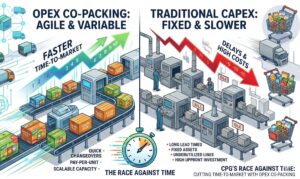
Retailer demand is increasingly spiky, driven by algorithmic ordering and short-notice promotions. When a retailer orders a 30% surge in volume for a specific variety pack, manufacturers with rigid, fixed-asset packaging lines physically cannot ramp up production fast enough to fill the order.
They ship what they have (short-shipping), and they eat the 3% fine.
The ‘Surge Capacity’ Strategy
Forward-thinking Supply Chain VPs are no longer viewing contract packaging (co-packing) merely as an outsourcing play. They view it as an OTIF Insurance Policy.
By maintaining a “warm” relationship with a co-packer, brands create external surge capacity. When the internal line hits its speed limit, the overflow volume shifts to the external partner.
- Cost of Co-Packing: Higher per-unit cost than internal production.
- Cost of OTIF Failure: 3% of COGS + potential delisting + lost revenue.
When you run the math, paying the co-packer’s premium on the surge volume is almost always cheaper than paying the retailer’s fine on the missed volume.
The Bottom Line
OTIF is no longer just a scorecard metric; it is a board-level financial risk.
If your internal lines cannot handle 120% of your projected peak demand, you are structurally set up to fail the “In-Full” requirement. It is time to stop blaming the trucks and start looking at the pack station.