
Walk into a modern distribution center, and you see the future.
Autonomous Mobile Robots (AMRs) glide across the floor. A Warehouse Management System (WMS) orchestrates inventory movement with algorithmic precision. Conveyors sort thousands of units per hour.
Then, follow that product to the end of the line.
The movement stops. The high-speed flow crashes into a row of tables where people manually construct corrugated boxes, insert bubble wrap and apply tape with hand guns.
This is the “Throughput Ceiling.”
Logistics leaders often invest millions to optimize picking and shipping, yet leave the critical middle step—packaging—in the manual era. In 2026, this imbalance does not just hurt efficiency; it creates a hard cap on revenue.
The Labor Cliff is Not a Phase
For the last decade, the primary argument for packaging automation was ROI based on labor savings. The logic was simple: “A machine is cheaper than three people.”
That math has changed. Today, the driver is not cost savings; it is business continuity.
The logistics sector faces a structural labor cliff. Warehouse turnover rates hover near 40% annually. For dull, repetitive tasks like erecting boxes or taping cartons, that number often spikes higher.
Operations directors cannot fill these roles. When a facility needs to scale output by 20% for peak season, the old playbook—”hire more temps”—fails because the people do not exist.
If your packing line requires 10 people to hit a daily quota, and you can only staff six, your throughput drops by 40%. It does not matter how fast your pickers work; the boxes cannot leave the building.
Manual reliance has transformed from a variable cost into a critical operational risk.
The Physics of the Bottleneck
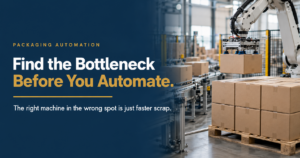
Goldratt’s Theory of Constraints dictates that a system can only move as fast as its slowest component.
In many facilities, the packing station acts as the governor on the engine.
- Picking Speed: 500 lines per hour (Optimized)
- Sorting Speed: 1,000 units per hour (Optimized)
- Packing Speed: 40 boxes per hour per person (Manual)
To match the upstream speed, the facility must linearly scale packing labor. To double output, you must double the packing staff and the floor space they occupy.
Eventually, you run out of square footage. You hit the Throughput Ceiling.
Automation as a Risk-Reduction Lever
Leading industrial operations now view packaging automation as an infrastructure investment, similar to HVAC or racking.
Automated packaging systems—such as case erectors, sealers, and auto-baggers—decouple throughput from headcount.
- Consistency Under Pressure: A semi-automated case sealer processes 25 cases per minute at 8 a.m. and 25 cases per minute at 4 p.m. It does not fatigue.
- Scalability: When volume surges, you do not need to recruit and train 20 new workers. You simply run the equipment longer.
- Space Reclamation: Automated systems typically occupy 30-50% less footprint than the equivalent manual packing tables. This frees up valuable square footage for inventory storage.
Planning for Scale Without Over-Capitalizing
The fear of “over-capitalizing”—buying a Ferrari when you need a sedan—often stalls automation projects.
However, modern packaging automation is modular. You do not need to replace the entire line at once.
- Phase 1: Automate the most repetitive task. Install a case erector to build boxes automatically. This feeds manual packers who simply fill and push. Throughput increases by 30%.
- Phase 2: Automate the closure. Install a random case sealer that automatically adjusts to different box sizes and tapes them. Throughput increases another 20%.
- Phase 3: Full automation. Implement auto-bagging for small e-commerce orders, removing boxes entirely for specific SKUs.
This “crawl, walk, run” approach allows operations to break the Throughput Ceiling incrementally without a massive initial CapEx shock.
Next Steps for Logistics Leaders
Look at your peak season data. Did you miss shipping windows because you couldn’t pick the product, or because you couldn’t get it into a box and onto the truck?
If the bottleneck was the pack station, you have a manual risk problem.
Do not let a $15 tape gun dictate the speed of your $50 million facility.
Korpack specializes in “right-sized” automation. We audit your specific throughput constraints and deploy equipment that breaks the bottleneck without breaking the budget.
Contact our industrial engineering team to calculate your true throughput potential.