
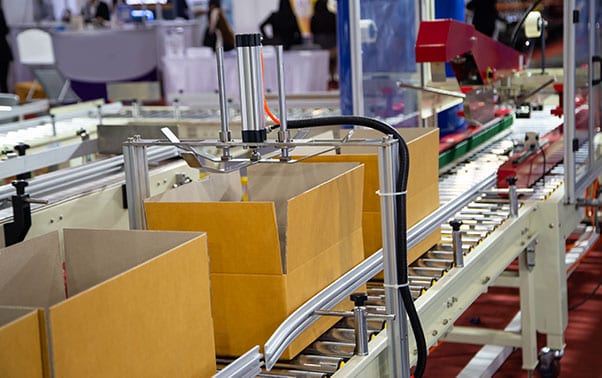
Semi-Automatic Case Sealing Machines
You might have realized by now that making your employees form, tape, pack, and close boxes are not the most efficient way of doing things. If that’s the case, it is time for you to add a Case Sealer machine to your packaging line.
Adding a case sealer to your plant or warehouse will significantly improve your team’s efficiency and output. It will also ensure every product you ship is correctly sealed and looks professional.
Now, with so many options available in the marketplace, selecting the right sealer can be quite overwhelming – semi-automatic vs. automatic, only a top seal vs. top and bottom seal, and so on.
Choosing the right sealer for your operation is a critical step to have an efficient and cost-effective process. To help you select the right sealer for your needs, we prepared this post with the things you need to consider when buying a case sealer.
Do you need an operator?
When you picture integrating a case sealer into your production line, what do you think about? Do you see an operator involved in the sealing process? Or would you prefer to have a fully automated production line?
As we told you above, there are semi-automatic and fully automatic case sealers you can choose from; you must set your expectations before investing in any of them.
If you want an operator involved in the process, then a semi-automatic case sealer might be the right fit for you.
A semi-automatic case sealer will require someone to operate the machine. Having an operator might work for you if you have no problems finding skilled workers or other tasks require the operators to be close by.
However, if you instead prefer a machine that does the work independently, then a fully automatic case sealer would be a better solution for you.
What’s your production rate?
Your production rate will play a significant role in what case sealer will work for your packaging line. If you want to justify the purchase of a case sealer, your warehouse should be sealing around 150 or more cases per day.
Once you have determined that you need the equipment, start looking for the best model that fits your production volume.
You need a case sealer that maximizes your throughput and manages your demand.
If your operation needs to run around 50 boxes/day, you might need a semi-automatic case sealer.
Now, if your packaging line has a production rate of about 250+ boxes/day, a fully automatic case sealer will be the best choice to keep up with your high demand automatically
What does your operation need?
Every warehouse does things differently, so there is no “one-size-fits-all” solution for case sealers. This is why you need to understand your warehouse’s operation on a typical day if you want to find a case sealer that fits your needs.
Do an inventory of all the case sizes you use, from smallest to largest. Does the sealer you want to buy have the ability to handle these sizes? What’s the usual weight of your products? How much inventory do you move in a day?
When choosing a unit, you need to consider all of this and then select a case sealer to fulfill your warehouse’s requirements.
How much space do you have?
You also need to consider how much space you have available for the equipment. Keep in mind that case sealers come in different sizes, so it’s better to check this beforehand to avoid surprises.
A good thing to look at when buying a case sealer is the machine’s size and the available space you have for it inside your warehouse. Pick a spot for your case sealer before you start looking at different models. This way, you will pick one with the correct size.
If you don’t have that much space, you might not have room for a sizeable automatic case sealer. If that’s the case, a smaller, more compact semi-automatic case sealer will be the best option. If you’re realistic about the space you have and use it wisely, there’s a case sealer that will match what you need.
Contact Us today and we will help you determine what option is best for your current and future needs.