
Since the beginning of 2020, supply chains all over the world have been subjected to unprecedented challenges, which have led to costly disruptions. Most businesses emerged from these trials with a better sense of what it takes to make their supply chains more resilient.
In response to the turbulent events of the last few years, countless organizations have modernized their supply chains by leveraging new software, hardware, business processes, and automation technologies.
However, the combination of inflation and unpredictable demand for goods and services has raised concerns that new supply chain challenges are just over the horizon.
Fortunately, it’s possible for your organization to protect business continuity and promote supply chain resilience by embracing several key supply chain trends. These trends are poised to transform how businesses manage supply chains in 2023 and beyond.
Here are the supply chain trends and predictions your business needs to be aware of as it navigates the opportunities and hurdles of 2023.
Businesses Will Move Into Growth Mode
For the last two years, businesses have been spending time reacting to all of the supply chain issues rather than strategically planning for the future. With the start of the new year and major shifts in supply chain, companies will now shift to a proactive approach allowing for growth.
Now is the time to reevaluate overall supply chain strategies and business models. There will be more breathing room and a chance to dive deep into current supply chains to find out what is or is not working. Companies will take what they learned about being quick and agile and pair that with long-term strategies. The combination and balance of the two will send companies straight into growth mode, allowing them to keep a safe amount of reactionary thinking while focusing on long-term trends and goals without panicking.
Automation Technologies Will Help You Contend with Labor Shortages
Our biggest prediction for 2023 is that automation technologies will play a key role in contending with ongoing labor shortages. If your business is among the many struggling to source and hire skilled laborers, it’s vital that you leverage automation to fill in the productivity gaps.
Automation technologies will let you do more with less, support the efforts of existing staff, and reduce the workload on your team to promote better morale. Cumulatively, these efforts will help you retain the staff you have and make them more productive in the process.
Where do you implement automation technologies into your business model? The simple answer is everywhere.
As you begin exploring additional use cases for automation, you should conduct a comprehensive analysis of your current operations. Identify which teams or departments have experienced the biggest reduction in productivity due to labor shortages and inefficient processes.
From there, you can begin to systematically implement automation tools into these mission-critical processes to increase productivity.
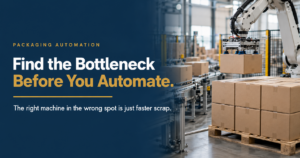
Packaging and product preparation processes present excellent opportunities to implement automation machinery. These traditionally labor-intensive procedures can be streamlined using robotic stretch wrap machines, strapping equipment, and similar tools.
Data and Visibility
This trend has been emerging for quite some time but will ramp up in 2023 and stay around for a while – utilizing data to gain insight and visibility into a company’s supply chain. This will help your supply chain and nearly every aspect of a business.
Technology that prioritizes data and visibility will be in high demand in 2023 with the optimization of supply chains. These technologies and data will be used to increase efficiency and accuracy throughout the supply chain process by removing manual processes and the potential for human error.
Supply chain managers will look for visibility into tracking goods and shipments, sourcing, manufacturing, and distribution. The more visibility and data available, the better.
Reducing Risk and Strengthening Back-Up Plans
Companies have been rampaged with challenges over the last several years, and with inflation and the threat of a recession, they need to be more prepared than ever.
Trends show that businesses are doing just that by reshoring efforts and driving visibility into their suppliers. After dealing with overseas issues and shortages, companies are prioritizing nearshore and domestic vendors. That way, if another significant supply chain disruption occurs, the vendors close to your business will be invaluable partners in overcoming the resulting disorder.
As mentioned before, visibility is a huge trend for the coming years, and companies are pushing for even more visibility with their vendors to help mitigate risk. Managers and executives need help with the uncertainty of issues such as lead times, SKU rationalization, rising costs, and labor shortages. They will be looking to their vendors to provide transparency and guidance.
How Korpack Can Help You Future-Proof Your Supply Chain
As you can see, several emerging supply chain trends are reshaping how businesses manage the flow of goods and materials into and out of their facilities.
The businesses that thrive will embrace these innovative practices, modernize their operations, and optimize efficiency through strategic partnerships and the deployment of robust new technologies.
Can your organization keep up in the supply chain of the future? It can, with Korpack in its corner.
Korpack is an extension of your business that can help you grow and scale in the coming years. We are supply chain and packaging experts that will support you far more than just being your vendor. Utilizing a dynamic ERP system combined with our years of expertise, we can help optimize your supply chains by providing data, visibility, and reassurance.
At Korpack, we connect our valued clients with high-quality packaging materials and cutting-edge machinery. Our dynamic suite of solutions can expedite the process of packaging goods by enabling you to leverage time and resource-saving automation technology.
Are you ready to future-proof your supply chain through innovation? If so, you can contact Korpack to learn more about how we can help. You can also request a custom quote on machinery or packaging supplies.