

Most packaging problems don’t start with materials.
They start with ownership.
When packaging is handed off between marketing, procurement, and operations with no technical lead at the table, small inefficiencies compound into real delays — and costs.
It’s not a question of creativity. It’s a question of structure.
And without packaging engineering involved early, structure breaks down.
The invisible bottleneck
The product’s ready. The campaign is approved. Retail timelines are locked in.
Then the packaging starts slipping.
-
Renderings don’t match final product specs
-
Dielines are built around guesses, not tolerances
-
Compliance questions get flagged too late
-
The prototype looks good — until it hits a pallet
-
Freight costs climb because cube efficiency was never modeled
-
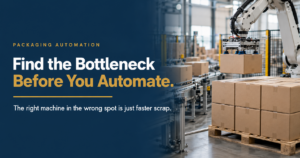
Packaging doesn’t run cleanly through automation
None of this feels like a crisis at first. But across SKUs, across launches, it becomes a pattern:
Packaging is the bottleneck.
Why it happens
Because in many organizations, packaging is no one’s core responsibility.
It’s treated as a creative brief. Or a vendor task. Or a last-mile operational step.
But it’s not owned by engineering — and that’s where the disconnect begins.
You wouldn’t develop a product without technical specs.
You wouldn’t run logistics without data.
But companies still launch packaging without engineering discipline.
The business cost of waiting too long
By the time packaging issues surface, your options shrink.
-
Retailers ask for revisions — and your delivery slips
-
Prototypes need rework — and your budget expands
-
Freight costs balloon — because the master case is inefficient
-
Products arrive damaged — and you lose trust
-
Internal teams lose momentum — and the next launch starts compromised
Packaging problems are rarely isolated. They ripple.
And they slow down the very systems you’re trying to scale.
What changes when engineering leads
Packaging engineering isn’t just about renderings and tolerances.
It’s about building packaging as infrastructure — not artwork.
When engineers lead:
-
Specs match the product, the retailer, and the automation line
-
Materials are right-sized for protection and freight
-
Dielines, palletization, and ship tests happen early
-
Regulatory and label compliance are locked before artwork
-
Prototypes aren’t approximations — they’re final approval assets
-
Launches move forward with fewer decision loops and less revision churn
It’s not just faster. It’s predictable.
And that’s what matters in real-world execution.
Engineering is not optional — it’s operational strategy
As brands grow more complex, and SKU velocity increases, the companies that scale successfully are not the ones with the best ideas. They’re the ones with the tightest execution systems.
Packaging, when engineered properly, stops being a wildcard.
It becomes a controllable lever — for speed, cost, and confidence.
If you’re serious about growth, bring your engineers into the packaging conversation before the bottleneck shows up.
Korpack helps brands eliminate packaging guesswork with engineer-led systems that scale.
Let’s design something that works — everywhere it needs to.
→ Talk to our team