
A transformer bushing leaves your dock in good shape. Three weeks later it reaches a customer in another country, they open the crate, and the porcelain is cracked. Now you are re-machining the part, paying air freight to get the replacement there fast, running the customs paperwork a second time, and processing a warranty claim. The part was the cheap part. Everything that happened because it broke is what actually costs you.
Most electrical and electronics manufacturers carry this cost without ever seeing it in one place. It shows up as scattered warranty claims, freight write-offs, and customer credits, each booked separately, none of them tagged “packaging.” Added up across a year of shipments, it is rarely small. And the packaging that caused it usually wasn’t designed at all. It was inherited: a crate spec set up years ago, foam chosen once, a pallet pattern nobody has revisited since the product changed.
What In-Transit Damage Actually Costs
Packaging Digest has reported that as much as 11% of unit loads arriving at a distribution center show some level of case damage. Every handoff adds to that exposure: the dock, the line haul, the cross-dock, the receiving warehouse. Export a load and you add a port, a vessel, and a foreign customs handler to the list.
Three things make electrical and electronics shipments costlier than the average freight when they fail:
- The parts are expensive. A transformer bushing, a switchgear assembly, or a control unit represents real material plus the machining and engineering that went into it. Replacing one is not a rounding error.
- They break in ways you can’t see. Porcelain and epoxy insulators crack under shock. Castings chip on the edges. Circuit assemblies fail from vibration that leaves no mark on the outside of the box. Often nobody knows the part is bad until it gets installed or energized, which means the failure surfaces at the worst possible moment.
- Your customer is usually another manufacturer. If your component feeds someone else’s production line, a damaged shipment can stop that line. Industrial packaging analysts have noted that in B2B relationships, a supplier can end up on the hook for the customer’s downtime, not just the broken part.
The replaced part is the cost you can measure. The one you can’t is the customer who stops trusting your shipments to arrive intact and quietly brings on a second supplier. By the time that shows up in your numbers, it looks like a sales problem, not a packaging one.
The broken component is usually the smallest line on the bill:
- Replacement part: material, machining, labor
- Expedited freight to re-ship, often air freight on an export order
- A second round of customs, brokerage, and documentation
- Warranty claim handling and admin time
- Possible liability for the customer’s line downtime
- Lost trust, and the second supplier it invites in
For Exporters, the Packaging Itself Can Stop the Shipment
If you ship internationally, damage is not the only packaging risk you carry. The wood your product sits in can get the whole load held at the border, and most manufacturers don’t think about it until it happens.
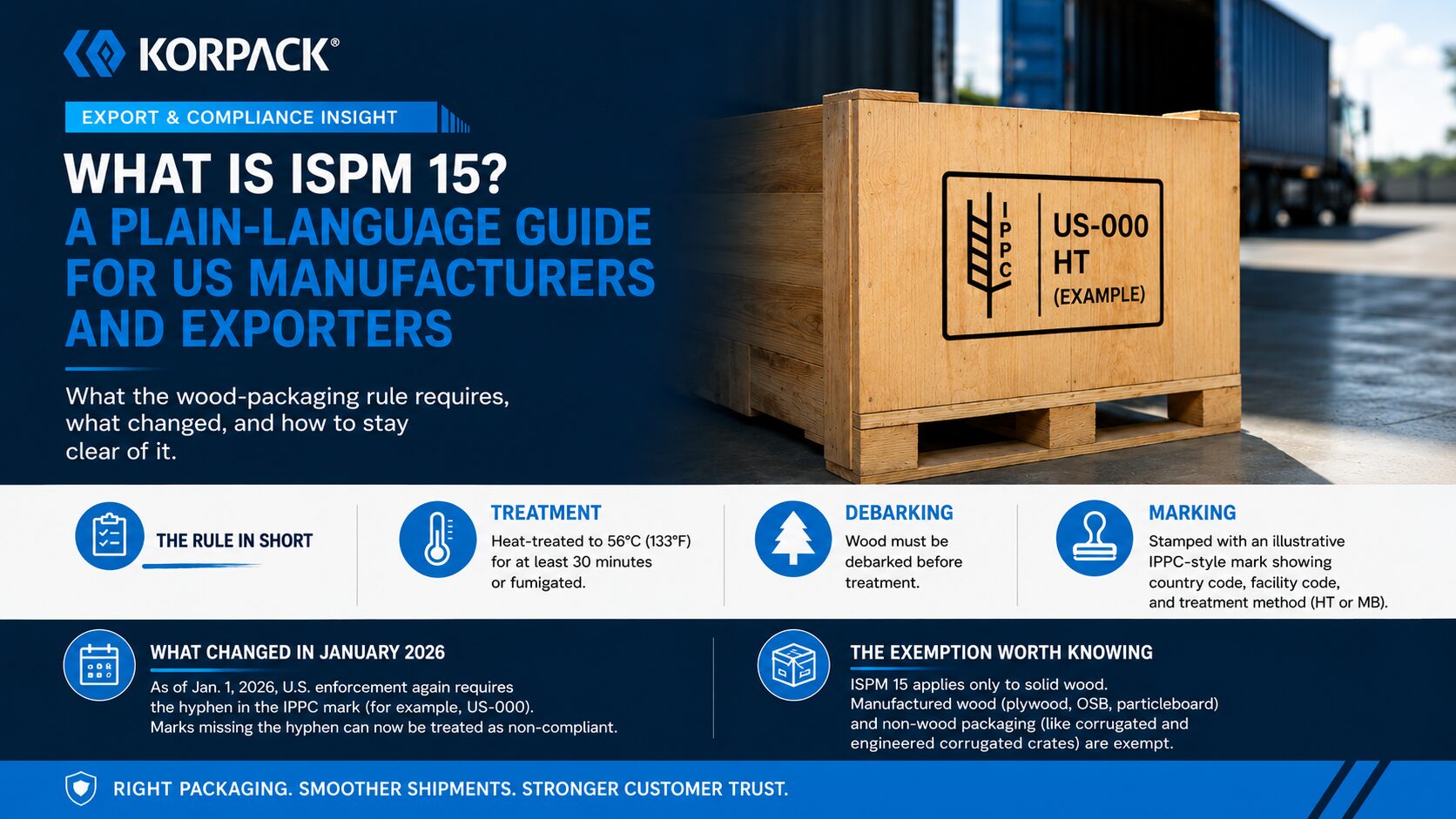
The rule is ISPM 15, the international phytosanitary standard for solid wood packaging: pallets, crates, and dunnage used in cross-border trade. It is recognized across the more than 180 member countries of the International Plant Protection Convention and enforced by every major trading nation, including the US, the EU, China, and India. The point is to stop wood packaging from carrying pests between countries, and the requirement is specific. Any solid wood in your export packaging has to be heat-treated to a 56°C core for at least 30 minutes, or fumigated with methyl bromide, then stamped with the IPPC mark by a certified facility. Modify or repair a treated crate and it has to be treated and marked again.
Miss the requirement and the destination country can delay the shipment, refuse it, hold it for fines, fumigate it on arrival, or destroy it. For a manufacturer sending switchgear or transformer components to customers in several countries, every wooden crate in that stream is one more thing that can blow a delivery window on a high-value order, and one uncertified crate is enough to do it.
ISPM 15 only covers solid wood. Processed wood like plywood and OSB is exempt, and corrugated packaging sits outside the standard entirely. Move a crate from solid wood to engineered corrugated and the heat-treatment and fumigation requirement simply goes away for that part of your packaging, along with the weight and the splinters.
It is also worth noting that methyl bromide, one of the two approved wood treatments, is being phased down under an IPPC recommendation on environmental grounds, which leaves exporters increasingly reliant on heat treatment or on materials outside the standard altogether.
Why Wood Crates Stuck Around, and Why That’s Ending
Wood became the default for heavy electrical equipment because it is strong, cheap, and everywhere. Those are real advantages. But the wooden crate carries costs that have gotten harder to wave off:
- Weight. Wood is heavy, and you pay for that weight on every shipment. On air-freighted export orders, it hurts the most.
- Compliance. Every solid-wood crate in the export stream needs ISPM 15 treatment and marking, and re-treatment if it’s modified.
- Handling and safety. Nails, screws, splinters, and dead weight make wood crates an injury risk and an ergonomic headache at both the pack and unpack ends.
- Self-inflicted damage. Loose hardware and rigid wood pressing on finished surfaces can mar the product the crate is supposed to protect.
- No engineering behind it. Wood crates tend to get built by habit, with little thought given to how the specific part inside is cushioned and held in place.
The fix is not flimsier packaging. It is packaging that was actually engineered: designed around the product’s real fragility points, weight, and the trip it takes, with materials picked for a reason instead of inherited.
What Engineered Transit Protection Looks Like
Cutting transit damage is a discipline, not a matter of adding foam until it feels safe. For electrical and electronics shipments, a few things have to work together:
- Protection matched to the failure mode. Shock, vibration, compression, and abrasion are different problems with different answers. A porcelain insulator needs shock isolation; a stacked pallet load needs compression strength and stability. Good design starts by figuring out how the specific part actually breaks.
- A tight fit. Most damage comes from the product moving inside the box. Cushioning and partitions sized to the part hold it still and take the collisions out of the equation.
- A real pallet plan. How units are arranged, stacked, and secured decides whether the load survives every handoff. Pallet configuration drawings, which most large receivers require anyway, also pack more into the same cube and cut freight cost.
- Export built in. Choose packaging with ISPM 15 in mind from the start, either certified-treated wood or exempt materials like corrugated, so the export stream doesn’t carry a compliance surprise.
- Testing. The only way to know a package protects the product is to test it before the full run, not after the first damaged shipment comes back.
That is packaging engineering, and it is a different thing from packaging procurement. A procurement relationship sells you the crate you ask for. An engineering one asks why the part keeps arriving broken and designs the answer.
How Korpack Solves This
Korpack treats transit protection as an engineering problem with a number attached to it. Three things are directly relevant to damage and export risk.
Korpack was founded by a packaging engineer, and its accredited packaging engineers, many recruited from Michigan State University’s packaging program, the first and top-ranked program of its kind in the country, look at each job for quality, efficiency, cost, and design rather than pulling a stock spec off a shelf.
For an electrical manufacturer, that means someone who will work out how your components fail in transit, design protection around those failure points, produce the CAD files, spec sheets, 3D renderings, and pallet drawings, and prototype and test the result before you commit to a production run.
For heavy or fragile electrical equipment, an engineered modular corrugated crate does what a wood crate does without the wood-crate problems:
- Lighter than wood, so it cuts freight cost on every shipment and saves the most on air-freighted exports
- Outside ISPM 15, so corrugated construction drops the heat-treatment and fumigation step that wood requires
- Safer to handle, with no nails, screws, or splinters and far less weight to lift
- Durable and reusable, strong enough to stand in for wood while staying renewable and recyclable
- Often cheaper overall once you add up material, assembly labor, and shipping weight
Korpack supplies and fabricates modular corrugated crates as an engineering-led packaging partner, keeps corrugated crate stock on hand, and can produce to spec within a couple of days.
Transit protection is rarely a single material. It is the crate, the interior cushioning, the partitions, the pallet pattern, and the freight. Korpack supplies all of it, corrugated and chipboard partitions, custom foam, molded pulp, and the rest of the interior protective packaging, alongside the crate and pallet engineering.
And because Korpack also handles supply chain support, vendor-managed inventory, and 3PL and warehousing, you can run the whole protect-and-ship function through one engineering-led partner instead of stitching together a crate vendor, a foam vendor, a pallet vendor, and a freight provider.
If damaged shipments keep landing on your warranty line, the fix is not a thicker box. It is an engineer who asks why the part is breaking and builds packaging that answers the question.
The Bottom Line
In-transit damage is a cost that hides because nobody owns the line item. It sits inside warranty claims, freight write-offs, and credits, and for exporters it comes with a second risk: an ISPM 15 slip that can park a high-value order at a foreign border over one uncertified crate.
Both come back to packaging that was inherited instead of designed. Fixing it means engineering the protection deliberately, testing it, and being willing to drop wood for materials that cut weight, damage, and compliance burden in one move.
The real question isn’t whether your products are arriving. It’s what it costs you when they don’t, and whether your packaging partner is doing anything about it.
Korpack’s packaging engineers can look at how your electrical and electronics components are failing in transit, design protection around those failure points, and show you where moving off wood crates cuts freight weight, damage, and ISPM 15 export-compliance burden at the same time. If broken shipments are showing up on your warranty line, let’s engineer them out.
Schedule a Packaging Engineering Review
855.567.7225 | korpack.com
Korpack is a technologically advanced packaging materials, contract packaging, and automation supplier that approaches solutions with an engineering mindset and creative flexibility. Founded by a packaging engineer, Korpack serves growth-oriented manufacturers across North America from its Chicagoland headquarters. This article is part of Korpack’s Industrial Insights series for electrical and electronics manufacturers.