

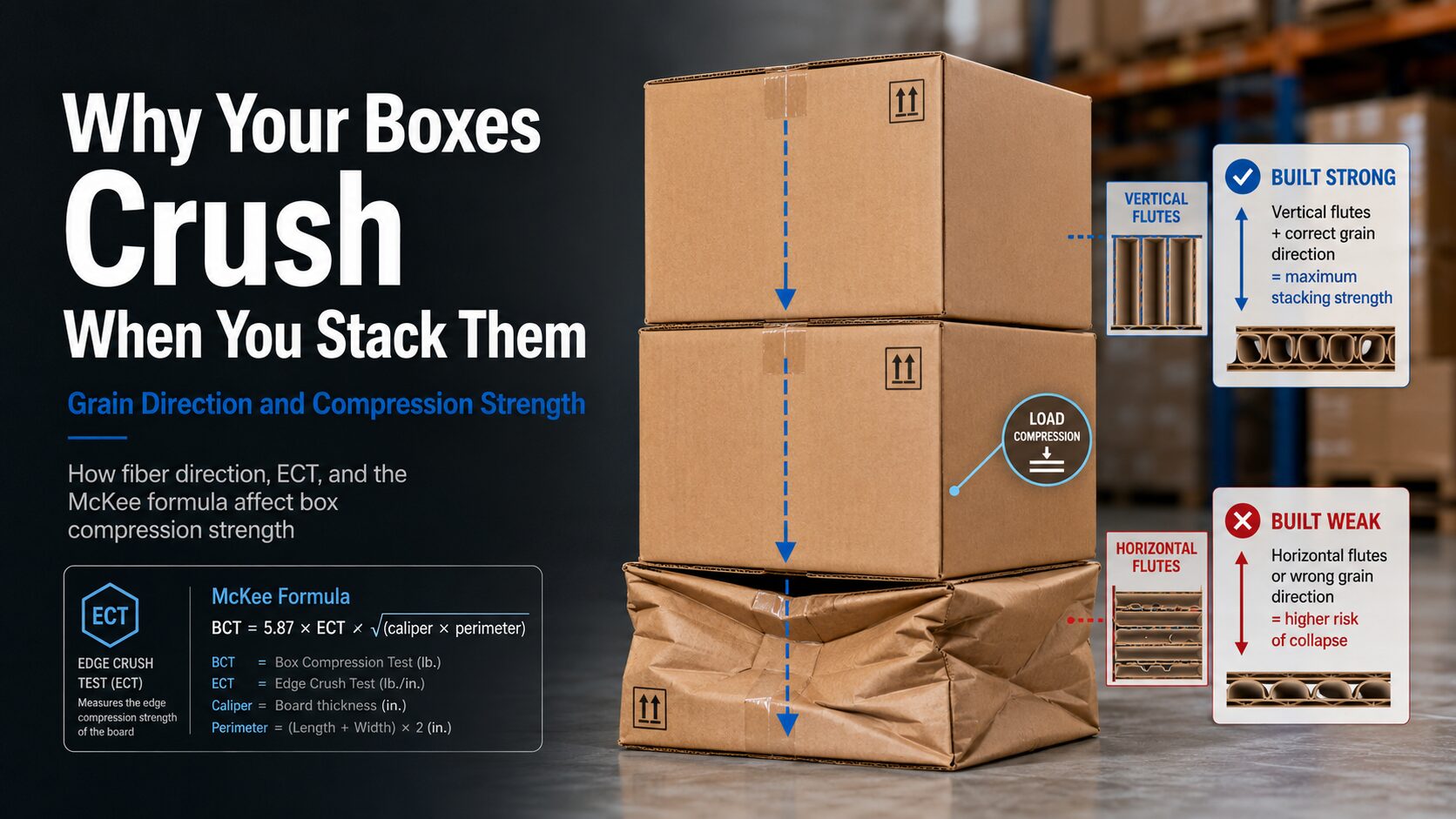
A corrugated box gets most of its stacking strength from one thing: the direction its fibers and flutes run. Paper is far stronger along the grain than across it, and corrugated flutes are far stronger standing vertically than lying flat. Get those two directions right and a box carries the load above it. Get them wrong and the same board, the same weight of paper, the same price, collapses under a fraction of the load it should hold.
This is why two boxes that look identical and cost the same can perform completely differently in a stack. It is also why “just order a stronger box” is often the wrong fix: the strength is usually already in the material; it is the direction that is being wasted. This guide explains how grain and flute direction drive compression strength, how that strength is measured and predicted, and why a box that passes in the lab still fails in the warehouse.
Where the Strength Comes From
Paper is made on a moving wire, and the cellulose fibers line up mostly in the direction the machine runs. That direction is called the machine direction (MD); the one across it is the cross direction (CD). Because the fibers are aligned with MD, paper is significantly stronger and stiffer along the machine direction than across it. That is grain direction, and it is built into the material before a box is ever cut.
In a corrugated board, the fluted medium adds a second, more powerful directional effect. Stand the flutes vertically, like a row of tiny columns, and they carry compression load extremely well. Lay those same flutes horizontally and they have almost nothing to push against; the board buckles. This is why flute orientation, not board thickness, is usually the first thing to check when a box is crushing.
Two different directional effects, often confused, both matter:
- Grain (MD vs CD): fiber alignment in the paper itself. Paper is stronger and stiffer along the machine direction.
- Flute direction: how the corrugated columns are oriented in the box. Vertical flutes carry stacking load; horizontal flutes carry very little.
- The rule of thumb: for a box that gets stacked, the flutes should run top-to-bottom, so the columns stand vertically between the load above and the floor below.
How the Strength Gets Measured: ECT
The standard way to measure a corrugated board’s stacking-relevant strength is the Edge Crush Test (ECT). It measures how much edgewise compression force the board can take before it crushes, reported in pounds per linear inch (for example, 32 ECT). ECT is the single best board-level predictor of how a box will perform in a stack, which is why it appears on the Box Manufacturer’s Certificate stamped on most cartons.
A common reference point: a single-wall 32 ECT board is generally rated to hold roughly 65 pounds of combined box-and-contents weight. Step up the ECT and the stacking capacity rises with it. The reason ECT predicts stacking strength so well is that it is measuring exactly the thing a stack demands: edgewise compression resistance, which is governed by those vertical flute columns and the fiber strength in the board.
How the Strength Gets Predicted: The McKee Formula
Board strength (ECT) is not the same as box strength. A box’s actual compression capacity also depends on its size and the board’s thickness. The standard tool for turning board strength into a box-strength estimate is the McKee formula, first published in 1963 and still in everyday use.
In its simplified form, box compression strength is estimated as BCT = 5.87 × ECT × √(caliper × perimeter), where BCT is the box compression strength in pounds, ECT is the board’s edge crush value, caliper is board thickness, and perimeter is the distance around the box. The practical takeaways from that equation matter more than the math:
- ECT scales the result directly. Improving the board’s edge crush is the most efficient lever for raising box strength.
- Bigger boxes are weaker. A larger perimeter spreads the same board over more unsupported wall, so a bigger box of the same board carries less per its own structure.
- It is an estimate, not a guarantee. McKee was derived for standard RSC boxes; unusual flutes, coatings, die-cuts, or internal supports change the result. The reliable confirmation is a physical box compression test under ASTM D642.
Take a 32 ECT board, 0.200 in thick, formed into a 12 in × 9 in box (perimeter = 42 in). McKee estimates: 5.87 × 32 × √(0.200 × 42) ≈ 545 lbs of compression strength. That is the lab figure for a fresh box. What the box actually holds in your warehouse is a different and smaller number, which is the part most specs miss.
Why a Box That Passes in the Lab Still Fails in the Warehouse
The McKee estimate and the ASTM D642 test both describe a fresh box, crushed once, fast, in controlled conditions. Real stacks do not work that way. Two forces quietly eat into that number, and a spec that ignores them is a spec that fails.
The first is humidity. Corrugated is cellulose, and cellulose absorbs moisture that breaks the hydrogen bonds giving paper its stiffness. Moving a 32 ECT board from lab conditions into a 70% relative-humidity warehouse can cut its strength by roughly 20%. At 80% RH the loss runs 30 to 40%, and at 90% it can exceed 50%. A box specified at warehouse-dry conditions can arrive from a humid ocean crossing at half the strength it was bought for.
The second is time under load, known as creep. Even in dry conditions, fibers slowly deform under constant weight, so a box that survives a five-minute lab test can buckle after weeks in a stack. Industry guidance commonly treats long-term usable strength as roughly 50 to 60% of peak lab BCT, and the Fibre Box Association’s storage-under-load multipliers put the loss at about 45% after 90 days under load, more in high humidity.
This is why packaging engineers apply a stacking (safety) factor rather than designing to the lab number. The factor stacks up the known hazards:
- Storage time under load (creep)
- Relative humidity in the warehouse, container, or trailer
- Pallet pattern and box overhang on the pallet edge
- Handling and transport abuse
Short-term storage might use a 2× factor; long-term humid storage can call for 4× or more. Skip the factor and you are designing the box for a test it will only ever take once.
The Fix Is Usually Direction, Not More Material
When boxes crush, the instinct is to order a heavier board. Sometimes that is right. Often it is the expensive version of a free fix. Before adding material and cost, the questions an engineer asks are:
- Are the flutes running vertically? A box stacked with horizontal flutes is throwing away most of its compression strength regardless of board grade. Reorienting the flutes can be free.
- Is the grain working with the box, not against it? Aligning the stronger machine direction with the box’s vertical load path puts the material’s natural strength where the stack needs it.
- Is the box right-sized? A box larger than the product needs has a bigger perimeter, which the McKee relationship says is weaker, and it wastes material at the same time.
- Is the spec built for the real environment? The right ECT and safety factor for a dry, short-term stack are not the right ones for a humid, long-stored, or ocean-freighted load.
Only after those are settled does adding board grade make sense. Done in the right order, the result is usually a box that holds better and often costs less, because the material is doing the job the direction was wasting.
How Korpack Solves This
Korpack approaches box strength as an engineering problem rather than a board-grade lookup. That means starting with how the box actually fails, then specifying material and direction to match.
Korpack’s accredited packaging engineers design corrugated to the load, the stack, and the environment it will live in, specifying flute orientation, board grade, and ECT against the real distribution conditions, not just a lab number. CAD files, spec sheets, 3D renderings, and pallet configuration drawings document the design, and prototypes can be tested before committing to a production run.
A Korpack Plant Audit Review catalogs the packaging in your operation and flags both failures and waste: boxes crushing because the direction or grade is wrong, and boxes over-specified with more board than the load needs. Both cost money. The audit turns “our boxes keep collapsing” into a specific, fixable list.
For prototypes, small runs, and one-off custom sizes, Korpack’s QuicKOR digital cutting capability produces corrugated cut to any shape without the cost of cutting dies, useful for right-sizing a box or testing a corrected design quickly before scaling it up.
The Bottom Line
Compression strength is not a single number printed on a box. It is the result of fiber direction, flute orientation, board grade, box size, and the conditions the box actually lives in. The McKee formula and an ECT rating give you a starting estimate; humidity, creep, and stacking realities decide whether that estimate survives contact with your warehouse.
When boxes crush, the answer is rarely just “more cardboard.” More often it is getting the direction right, sizing the box to the product, and specifying for the real environment, in that order. That is the difference between buying boxes and engineering them.
Most collapsed boxes are not weak. They are strong in the wrong direction.
Korpack’s packaging engineers can review why your boxes are failing, correct the flute and grain direction, right-size the box, and specify ECT and safety factors for the conditions your boxes actually face, often holding more load for the same or less material. A Plant Audit Review is where it starts.
855.567.7225 | korpack.com
Frequently Asked Questions
What is the difference between grain direction and flute direction?
Grain direction refers to how the cellulose fibers line up in the paper itself; paper is stronger along the machine direction than across it. Flute direction refers to how the corrugated columns are oriented in the finished box. Both affect strength, but for stacking, flute orientation usually matters most: vertical flutes carry compression load, horizontal flutes carry very little.
Which way should the flutes run for a box that gets stacked?
Top to bottom. When the flutes run vertically, they form columns between the load above and the floor below, which is the orientation that carries compression load best.
What is ECT and what does a number like 32 ECT mean?
ECT is the Edge Crush Test, the edgewise compression strength of the board in pounds per linear inch. A 32 ECT single-wall board is generally rated to hold around 65 pounds of combined box and contents. It is the board-level number that best predicts stacking performance.
What is the McKee formula?
It is the standard estimate for box compression strength: BCT ≈ 5.87 × ECT × √(caliper × perimeter). Published in 1963, it converts a board’s ECT, thickness, and box size into a predicted box strength. It is a reliable first estimate for standard boxes but should be confirmed with a physical compression test (ASTM D642) when margins are tight.
Why does my box pass testing but still collapse in storage?
Lab tests measure a fresh box crushed once in controlled conditions. In a real stack, humidity and time under load both reduce strength. A board can lose around 20% of its strength at 70% relative humidity and 30 to 40% at 80%, and long-term usable strength is often only 50 to 60% of the peak lab figure. Designing to the lab number without a safety factor is the usual cause.
- McKee, R.C., Gander, J.W., and Wachuta, J.R., “Compression Strength Formula for Corrugated Boxes,” Paperboard Packaging, 1963. Source for the McKee formula and the ECT-to-BCT relationship, as documented in current engineering references and box-compression calculators (Westpak, PackCalc, Esko).
- ASTM International, ASTM D642 (box compression testing), ASTM D4577 (compressive creep of shipping containers), and TAPPI T811 (edge crush testing). Source for the standard test methods referenced.
- Industry compression and humidity references, including Powell Systems (2026), PackCalc, and Anchor Box (2025) for ECT load ratings (32 ECT ≈ 65 lbs) and humidity derating (roughly 20% at 70% RH, 30–40% at 80%, over 50% at 90%); and the Fibre Box Association storage-under-load and relative-humidity multipliers for time-under-load (creep) losses (about 45% after 90 days under load; long-term usable strength roughly 50–60% of lab BCT) and stacking/safety factor practice.
- Korpack Marketing Guidelines and Value Propositions, November 2023. Source for Korpack’s packaging engineering, box design, CAD/spec/prototype capabilities, Plant Audit Reviews, pallet configuration, and QuicKOR / CADKOR custom corrugated.
Korpack is a technologically advanced packaging materials, contract packaging, and automation supplier that approaches solutions with an engineering mindset and creative flexibility. Founded by a packaging engineer, Korpack serves growth-oriented companies across North America from its Chicagoland headquarters. This article is part of Korpack’s packaging engineering education series. Formulas and derating figures are general industry references; confirm box performance with testing for your specific application.