

Finding a co-packer that says yes is the easy part. The expensive mistakes happen after you have committed a product, a launch date, and a customer’s shelf to a partner you qualified on a phone call and a plant tour. Qualifying a co-packer is the work you do before the first pallet ships, and it is cheaper than every alternative to it.
This article is a framework for that qualification, built around four questions. Can they do the work? Can they do enough of it, when you need it? Will it be right every time? And do they fit the way you operate? Capability, capacity, quality systems, and fit. A partner can pass one and fail another, which is why you check all four before you ship anything.
One note first. This is general operational guidance, not legal, regulatory, or quality-assurance advice for any specific operation; confirm your own requirements with your quality and regulatory teams. Korpack is an engineering-led packaging supplier and co-packer that performs secondary packaging, labeling, relabeling, kitting, display building, and co-packing of already-made product. Korpack does not manufacture or fill the product, and the specification stays with the brand.
Start With the Specification, Not the Partner
You cannot qualify a partner against a specification you have not written. Before any audit or quote, you need the specification in hand: the pack formats and counts, the labeling and compliance requirements, the case and pallet configurations, and the volumes and any seasonal pattern behind them. A vague specification gets a vague quote and a partner you cannot actually hold to anything. The cleaner the specification you can hand over, the more precisely you can qualify the partner against it, and the more accurately they can engineer and price the work.
Capability: Can They Actually Do the Work
Capability is whether the partner can run your work as specified, not something adjacent to it. The gap between the two is where launches slip.
- The formats you need, not the ones they have. A co-packer that runs a format close to yours is not the same as one that runs yours. Confirm the equipment and tooling match the exact pack formats, counts, and closures your specification calls for, and that they have run them at volume before, not just in principle.
- Handling for your specific product. Temperature sensitivity, fragility, food contact, and fill state all change what safe handling looks like. The partner has to be set up for your product’s requirements, not for product in general.
- Engineering support, not just line time. There is a real difference between a partner who will run exactly what you hand them and one who can engineer the case, the unit load, and the pack to survive distribution and meet a retailer’s requirements. If your specification still has open questions, you need the second kind.
- The range you will actually use. If you need kitting, display builds, relabeling, or variable-data labeling now or soon, confirm those are in-house capabilities, not promises. Work that gets subcontracted a second time is harder to control.
Capacity: Can They Do Enough, When You Need It
A partner can be fully capable and still wrong for you, because they do not have room for your volume when you need it. Capacity is capability over time.
- Headroom. Find out whether you would be one more customer on an already full plant. A partner running near capacity has no room to absorb your growth or your mistakes.
- Seasonal flex. If your demand has a peak, the question is whether the partner can follow it, and what else is competing for the same line during your peak. A partner whose peak is your peak is a scheduling conflict waiting to happen.
- Redundancy. One line or several? What happens to your schedule when a line goes down for maintenance or repair? A single point of failure in their plant becomes a single point of failure in your supply.
- Lead times and scheduling. Understand how far ahead they schedule, how they handle rush work, and how a change to your forecast ripples through their plant. The answer tells you how the relationship will behave under pressure.
Quality Systems: Will It Be Right Every Time
Capability tells you the partner can do it once. Quality systems tell you they will do it the same way every time, and catch it when they do not. For food and consumer products, this is where qualification gets specific.
- A recognized food-safety certification, if your product is food. The Global Food Safety Initiative, or GFSI, does not issue certificates itself. It benchmarks and recognizes third-party certification schemes, and a food co-packer should hold certification under one of them, such as SQF, BRCGS, FSSC 22000, or IFS. The certificate names the scheme and the scope it covers, so confirm the scope actually includes the work you need done.
- Regulatory registration. In the United States, facilities that manufacture, process, pack, or hold food for distribution are required to register with the FDA, and that registration must be renewed every two years. Confirm the partner’s registration is current and covers the facility that will run your product.
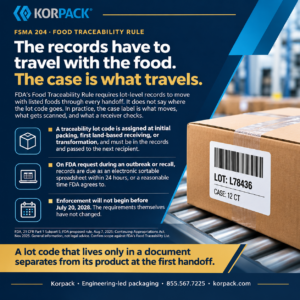
- Traceability and lot control. The partner has to be able to carry your lot code through their operation and hand the right data forward, so that a lot you ship can be traced through their plant and back. If you are subject to traceability requirements, their system has to connect to yours without a gap.
- Documented procedures and change control. Written procedures, controlled changes, and a real corrective-action process are the difference between a plant that runs on systems and one that runs on the memory of whoever is on shift. Ask to see how a change to your specification would be documented and controlled.
- Audit history, and how they handle findings. Every plant gets audit findings. What matters is whether they share them and how they close them. A partner who will show you their last audit and the corrective actions behind it is telling you something a clean-looking tour cannot.
A current certificate proves a system existed and passed on audit day. It does not prove the partner will run your product correctly at three in the morning during your peak. Use certification as a filter that removes the partners who should not be on the list, then verify the rest with your own audit and a trial run. The certificate gets a partner into the conversation; it does not end it.
Fit: Will the Relationship Work the Way You Operate
The first three questions are about the plant. The fourth is about the relationship, and it is the one brands skip and then regret.
- Transparency. Will they show you the floor, the records, and the findings, or only the conference room? A partner who is comfortable being audited is a partner who expects to pass. Reluctance is information.
- Communication under pressure. The relationship is defined by how a problem gets handled, not how a tour goes. Ask how they would tell you about a bad run, and how fast. The answer predicts the next two years.
- Financial stability and insurance. A partner you depend on has to be a business that will still be there, with the insurance to stand behind the work. This is basic due diligence that is easy to skip and expensive to skip.
- Where they put the specification. The most important fit question is whether the partner treats your specification as the floor or the ceiling. A partner who engineers to meet it exactly and flags what they cannot meet is worth more than one who quietly works around it.
Qualify on Paper, Then on the Floor, Then on a Pallet
Qualification is not one event. It is three gates, each cheaper than the failure it prevents. First, a document review: certifications, registrations, procedures, and references, which removes the partners who do not belong on the list. Second, an on-site audit, where you see whether the plant matches the paperwork. Third, a trial run or first article, where the partner runs a small quantity of your actual product against your acceptance criteria before you commit full volume. A partner who passes all three has earned the first real pallet. A partner who resists the third has told you something important.
How Korpack Fits
Korpack is an engineering-led packaging supplier and co-packer, and it is built to be qualified the way this article describes. The starting point is the brand’s specification as given; Korpack’s work is the secondary packaging, labeling, relabeling, kitting, display building, and case and unit-load engineering that executes it, with the plant and its records open to audit and the specification kept the brand’s throughout.
Practically, that means co-packing and pack-out engineered against your specification rather than run blind, labeling and barcoding operations that carry your lot code and compliance requirements through the work, and case and corrugated and unit-load configurations validated before anything ships at volume. Korpack performs the secondary packaging and co-packing; it does not manufacture or fill the product, and the determinations about your regulatory and certification requirements stay with you and your quality team.
The cheapest audit you will ever run is the one that happens before the first pallet ships. Every audit after that is cleanup.
Capability, capacity, quality systems, and fit are the four questions, and the trial run is the one that proves them. Korpack is an engineering-led co-packer built to be audited against your specification, with the case and unit load validated before full volume.
855.567.7225 | korpack.com
Frequently Asked Questions
What certifications should a food co-packer have?
For food, a co-packer should hold certification under a scheme recognized by the Global Food Safety Initiative, or GFSI, which does not certify directly but benchmarks third-party schemes such as SQF, BRCGS, FSSC 22000, and IFS. Confirm the certificate’s scope covers the specific work you need. Separately, in the United States, facilities that manufacture, process, pack, or hold food for distribution must register with the FDA and renew that registration every two years, so confirm the partner’s registration is current for the facility that will run your product. Certification is a filter, not a guarantee; verify with your own audit and a trial run.
How is qualifying a co-packer different from qualifying a co-manufacturer?
A co-packer handles packaging, assembly, labeling, kitting, and display building of a product that already exists, so qualification focuses on packaging capability, format match, labeling and traceability, and the quality systems around secondary packaging. A co-manufacturer actually makes or formulates the product, so its qualification reaches further into process controls, formulation, and ingredient management. The four questions, capability, capacity, quality systems, and fit, apply to both, but the depth and the specific controls you audit differ because the scope of work differs.
Should you run a trial before committing full volume?
Yes. A trial run or first article, where the partner produces a small quantity of your actual product against your acceptance criteria, is the single most informative step in qualification. It converts promises and paperwork into evidence, surfaces the problems a tour and a certificate cannot, and does it at a volume where a mistake is cheap. A partner who resists running a trial before full commitment is giving you useful information about how the relationship will go.
What is the most common mistake brands make when qualifying a co-packer?
Two are common. The first is trying to qualify a partner against a specification the brand has not fully written, which makes the quote vague and the partner impossible to hold to anything. The second is treating a current certificate as proof the work will be right, when a certificate only shows a system passed on audit day. The fix for both is the same: write the specification first, use certification to filter, and verify the rest with your own audit and a trial run.
- NSF, Comparing GFSI-Benchmarked Certifications, and Global Food Safety Initiative scheme documentation. Source for the statement that GFSI does not issue certifications itself but benchmarks and recognizes third-party schemes, including SQF, BRCGS, FSSC 22000, and IFS.
- US Food and Drug Administration, Food Facility Registration requirements, and biennial registration renewal guidance (industry reporting on FDA renewal, 2026). Source for the requirement that facilities which manufacture, process, pack, or hold food for distribution in the United States register with the FDA and renew that registration every two years.
- Korpack service descriptions and Marketing Guidelines. Source for Korpack’s co-packing, labeling, relabeling, kitting, display building, and corrugated and unit-load engineering operations. Korpack performs secondary packaging and co-packing of already-made product; it does not manufacture or fill product, and regulatory and certification determinations remain with the brand and its quality team.
Korpack is a technologically advanced packaging materials, contract packaging, and automation supplier that approaches solutions with an engineering mindset. Founded by a packaging engineer, Korpack serves growth-oriented food, beverage, and consumer brands and their manufacturers across North America from its Chicagoland headquarters. This article is general operational guidance, not legal, regulatory, or quality-assurance advice; certification and registration requirements should be confirmed with the relevant authorities and your own quality team.