

When a food recall happens, the question regulators ask first is not what went wrong. It is where the affected product went, and how fast you can prove it. The Food Traceability Rule, the part of the Food Safety Modernization Act known as FSMA 204, exists to make that answer fast and specific, and it does it by requiring certain records to travel with certain foods through every handoff in the supply chain.
Most of the writing about the rule is about data systems. That is fair, since the rule is a recordkeeping rule. But the records have to be connected to physical product moving between physical facilities, and the connection point, in practice, is the case: the lot code on it, the label that carries that code, and the shipping records that reference it. That is the part a packaging operation controls, and it is the part this article is about.
Two notes before the detail. This is general information, not legal advice, and Korpack is a packaging company, not a regulatory authority; confirm your obligations with counsel and with FDA’s own guidance. And Korpack’s role is secondary packaging, labeling, relabeling, and co-packing of already-made product; it does not manufacture food and does not operate traceability software.
What the Rule Actually Requires
The Food Traceability Rule, codified at 21 CFR Part 1, Subpart S, applies to foods on FDA’s Food Traceability List, and to foods that contain a listed food as an ingredient, provided the ingredient remains in the form in which it is listed. For those foods, it requires:
- Records at Critical Tracking Events. Specific records, with defined Key Data Elements, must be kept at harvesting, cooling, initial packing, first land-based receiving, shipping, receiving, and transformation.
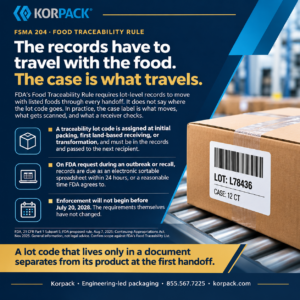
- A traceability lot code. A traceability lot code is assigned when a firm initially packs a raw agricultural commodity, first receives a food on land from a fishing vessel, or transforms a food. That code must appear in the Critical Tracking Event records and be linked to the Key Data Elements for that lot.
- A traceability plan. A written plan describing the firm’s recordkeeping procedures, how it identifies covered foods, how it assigns traceability lot codes, and a point of contact, with a farm map for firms that grow or raise a listed food other than eggs.
- Data that moves with the food. When a covered food is shipped, the shipper has to provide the traceability lot code and the other required Key Data Elements to the immediate recipient, so the information travels with the product rather than stopping at each company’s wall.
- An electronic sortable spreadsheet on request. When FDA asks, during an outbreak, a recall, or another public health threat, a firm, unless exempt from this requirement, must provide the relevant records as an electronic sortable spreadsheet within 24 hours, or within a reasonable time FDA agrees to.
That last requirement is the one that makes the rule different from ordinary lot tracking. Having the information somewhere is not enough. It has to be retrievable, sortable, and connected lot by lot, on a one-day clock.
The Date, Stated Precisely
The rule’s original compliance date was January 20, 2026. Here is the current situation, stated as exactly as the record allows, because this is where most summaries get loose.
On August 7, 2025, FDA published a proposed rule to extend the compliance date by 30 months, to July 20, 2028, citing the time affected companies would need to implement the requirements. Separately, a Congressional appropriations act enacted in November 2025 directed FDA not to enforce the rule before that same date, and FDA has stated that it intends to comply with that directive. So the practical effect is that the rule will not be enforced before July 20, 2028. Whether FDA has formally finalized the extension of the compliance date itself is a question to check against FDA’s current notices at the time you read this, because a proposed rule and a final rule are not the same thing.
The enforcement timeline moved, but the requirements did not. The Key Data Elements, the traceability lot code, the traceability plan, and the 24-hour sortable spreadsheet are unchanged. The extension is time to build the capability, not a signal that the capability is optional. Companies that treat 2028 as far away will discover that connecting lot codes across every handoff takes longer than it looks.
Is Your Product Even on the List?
Before building anything, check whether the rule applies to what you make, because it is narrower than its reputation. The Food Traceability List covers specific categories: soft and semi-soft cheeses (not hard cheeses); shell eggs; nut butters; fresh cucumbers, herbs, leafy greens, melons, peppers, sprouts, and tomatoes; fresh tropical tree fruits; fresh-cut fruits, fresh-cut leafy greens, and fresh-cut vegetables; finfish, smoked finfish, crustaceans, and molluscan shellfish in fresh, frozen, and previously frozen forms; and refrigerated ready-to-eat deli salads.
Equally important is what is not covered. Meat and poultry are regulated by the US Department of Agriculture, not by this FDA rule. Shelf-stable products such as dry pasta, canned goods, and shelf-stable sauces are not on the list. Frozen, shelf-stable, and aseptically processed cheeses are excluded. Soy and seed butters are excluded from the nut butter category. Foods for animals are not covered. A listed ingredient inside a product only brings the product into scope if the ingredient remains in its listed form; a fresh listed vegetable that has been cooked into a shelf-stable sauce does not, for example, make the sauce a covered food.
Two cautions follow. First, scope can be subtle, especially for mixed and processed products, and this is exactly the kind of determination to make with counsel and FDA’s own list rather than from a summary. Second, being outside the rule does not mean being outside traceability expectations. Retailers and major customers may require lot-level traceability from suppliers regardless of what the rule covers, and a recall of any food, listed or not, is still a traceability event.
Where the Case Comes In
The rule does not tell you where to put the traceability lot code. It does not require the code to be printed on the case label; it requires the code to exist, to be in the records, and to be provided to the next recipient. In practice, though, the case is what moves, what gets scanned at a distribution center, and what a receiving clerk looks at to confirm what arrived. A lot code that lives only in a document can be separated from its product at the first handoff. A lot code on the case label travels with it.
That is why the case label is where traceability usually becomes real for a packaging operation. Standard logistics labels can already carry lot and date information in machine-readable form alongside the shipping container code, and distribution centers already scan them. The traceability lot code has to be consistent across the item, the case, the pallet label, and the shipping documents, so that the lot referenced in the sortable spreadsheet is the same lot a receiver can find on a physical case. A mismatch anywhere in that chain is a gap in the 24-hour answer.
Every time a product is repacked, relabeled, kitted, or combined with other product, there is a decision about whether a new traceability lot code is created or the original one is carried through. Under the rule, transformation is a Critical Tracking Event that assigns a new code and links it to the inputs. A co-packer that handles covered foods has to know which operations create a new lot, carry that logic into its labels, and hand the right data to the next recipient. Getting this wrong does not show up until a recall, which is the worst time to discover it.
What to Build Now
- Confirm scope against FDA’s list. Determine, with counsel, which of your products and ingredients are covered, and document the determination in the traceability plan.
- Standardize the lot code across every level. One traceability lot code, carried identically on the item where applicable, the case label, the pallet label, and the shipping records, so the data and the physical product never disagree.
- Make the case label do the carrying. Specify case labels that carry the lot code and date in machine-readable form, verify they scan at the distribution center, and keep the label specification consistent across co-packers and plants.
- Map every transformation. Identify where repacking, kitting, or combining creates a new lot, and define how the new code is assigned, linked to its inputs, and labeled.
- Rehearse the 24-hour spreadsheet. Pick a lot and trace it forward and back, through every handoff, and produce the sortable spreadsheet on the clock. The gaps that exercise reveals are the ones to close before 2028.
How Korpack Fits
Korpack is an engineering-led packaging company and co-packer, and traceability touches its work at the point where the lot code meets the case. The starting point is the customer’s traceability lot code and labeling specification; Korpack’s job is to carry it correctly through secondary packaging, labeling, and any repack or kitting operation, and to hand the right data forward.
Practically, that means labeling and barcoding equipment specified to print and verify lot and date data on case labels, co-packing and relabeling operations run with lot discipline so that transformations are tracked rather than lost, and relabeling capacity for the moments when a lot has to be re-marked under time pressure. Korpack performs the secondary packaging, labeling, and co-packing; the traceability plan, the systems, and the regulatory determinations remain with the food company and its counsel. The objective is a case whose lot code matches its records at every handoff.
A traceability record you cannot connect to a physical case is a record about nothing. The case label is where the data and the product agree.
Traceability becomes real on the case label. Korpack’s labeling and co-packing operations carry your lot code through secondary packaging without breaking the chain, and supply the equipment to print and verify it.
855.567.7225 | korpack.com
Frequently Asked Questions
When does the FDA Food Traceability Rule take effect?
The rule’s original compliance date was January 20, 2026. On August 7, 2025, FDA published a proposed rule to extend that date by 30 months to July 20, 2028, and a Congressional appropriations act enacted in November 2025 directed FDA not to enforce the rule before that same date, which FDA has said it intends to honor. The practical effect is that enforcement will not begin before July 20, 2028. Because a proposed rule is not a final rule, check FDA’s current notices for the formal status of the compliance date. The requirements themselves have not changed.
Which foods are covered by the Food Traceability Rule?
Only foods on FDA’s Food Traceability List, and foods containing a listed food as an ingredient when that ingredient remains in its listed form. The list covers soft and semi-soft cheeses, shell eggs, nut butters, specific fresh produce (cucumbers, herbs, leafy greens, melons, peppers, sprouts, tomatoes, tropical tree fruits), fresh-cut fruits and vegetables, finfish, smoked finfish, crustaceans, molluscan shellfish, and refrigerated ready-to-eat deli salads. Meat and poultry fall under USDA, not this rule. Shelf-stable products such as dry pasta and shelf-stable sauces are not listed. Scope can be subtle for processed and mixed products, so confirm it against FDA’s list with counsel.
Does the rule require the lot code to be printed on the case?
No. The rule requires a traceability lot code to be assigned at specific events, included in the records, linked to the Key Data Elements, and provided to the next recipient when the food is shipped. It does not prescribe where the code physically appears. In practice, the case label is the most reliable carrier because the case is what moves, what distribution centers scan, and what a receiver checks, and standard logistics labels can already carry lot and date information in machine-readable form. A code that exists only in documents can be separated from its product at the first handoff.
What is the 24-hour sortable spreadsheet requirement?
When FDA requests records during an outbreak, recall, or other public health threat, a covered firm, unless exempt from this requirement, must provide the relevant traceability records as an electronic sortable spreadsheet within 24 hours, or within a reasonable time that FDA agrees to. This is what distinguishes the rule from ordinary lot tracking: the information has to be retrievable, sortable, and connected lot by lot on a one-day clock, which means the lot code on the physical case and the lot code in the records have to agree at every handoff.
- US Food and Drug Administration, FSMA Final Rule on Requirements for Additional Traceability Records for Certain Foods (21 CFR Part 1, Subpart S), agency web page, current as of November 2026. Source for the rule’s requirements: coverage of foods on the Food Traceability List and foods containing them as ingredients in listed form, Critical Tracking Events (harvesting, cooling, initial packing, first land-based receiving, shipping, receiving, transformation) with Key Data Elements, assignment and linking of the traceability lot code, the traceability plan, provision of Key Data Elements to the immediate recipient, and the electronic sortable spreadsheet within 24 hours of FDA request. Also source for the original January 20, 2026 compliance date, FDA’s proposal to extend it, the Congressional directive not to enforce before July 20, 2028, and FDA’s stated intent to comply.
- Federal Register, Requirements for Additional Traceability Records for Certain Foods: Compliance Date Extension, proposed rule, 90 FR 38084, August 7, 2025 (Document 2025-14967). Source for the proposed 30-month extension of the compliance date from January 20, 2026 to July 20, 2028, and its status as a proposed rule.
- Legal analysis of the November 2025 Continuing Appropriations Act provision directing FDA not to enforce the Food Traceability Rule before July 20, 2028 (Barley Snyder, 2025). Source for the enactment of the Congressional non-enforcement directive in November 2025.
- US Food and Drug Administration, Food Traceability List, agency web page. Source for the covered food categories quoted in this article and for the exclusions noted, including hard, frozen, shelf-stable and aseptically processed cheeses, soy and seed butters, meat salads, catfish, and foods for animals, and for the ingredient-in-listed-form condition.
- Korpack Marketing Guidelines and Value Propositions, November 2023, and Korpack labeling, co-packing, and relabeling service descriptions. Source for Korpack’s secondary packaging, labeling and barcoding, co-packing, and relabeling operations. Korpack does not manufacture food, operate traceability software, or provide legal or regulatory determinations.
Korpack is a technologically advanced packaging materials, contract packaging, and automation supplier that approaches solutions with an engineering mindset. Founded by a packaging engineer, Korpack serves growth-oriented food and beverage brands across North America from its Chicagoland headquarters. This article is general information, not legal advice; it reflects FDA’s published rule and notices as of November 2026, and compliance and enforcement dates may change. Confirm your obligations with counsel and with FDA.