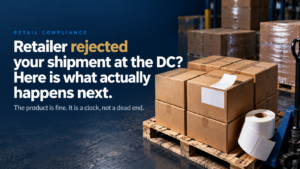


You get the call nobody wants: the shipment was refused at the retailer’s distribution center. The product is fine. The truck made it. But something about how the load was labeled, palletized, or documented did not match the retailer’s spec, and the DC turned it away at the dock. Now there is product in limbo, a receiving window slipping, and a chargeback clock already running. This is one of the most stressful situations in retail supply, and also one of the most fixable, provided the next few moves are the right ones.
This is a plain-language walkthrough of what a DC rejection actually is, why it happens, what your real options are once it does, and how a spec repack gets the product compliant and back on a truck. It is written for the person who just got the call and needs to know what to do in the next few hours, not the next few weeks.
Why the DC Turned It Away
The first thing worth understanding is that most DC rejections are not transportation failures. They are execution failures, problems with how the product was prepared, not how it was shipped. A distribution center runs on automated, high-speed receiving, and anything that breaks that flow gets stopped at the dock. The recurring culprits are consistent across retailers:
- Labeling and barcodes. A case or shipping label that does not meet the retailer’s spec, a barcode that will not scan, or an identifier that does not match the item file. Labels are the first thing a receiving team checks, and a failure here stops the shipment before it moves further.
- Palletization. Pallet height over the limit, weight out of range, the wrong stacking pattern, unstable loads, or non-compliant stretch-wrap. A pallet that does not meet the spec is a safety and handling problem for the DC, so it gets refused.
- Documentation and the ASN. A missing or inaccurate Advance Ship Notice, a mismatch between what the paperwork says and what is on the truck, or missing shipping-container labels. When the data does not reconcile to the purchase order, the receiving team loses trust in the whole shipment.
- Case pack and configuration. A case count that does not match the item file, or a display that did not arrive floor-ready. The pack has to match the specification the retailer is expecting, not the one the product was originally built for.
- The delivery window. Arriving outside the scheduled appointment can get a load refused regardless of product condition, because the DC’s receiving slots are tightly scheduled. This one is a logistics issue rather than a packaging issue, but it lands the product in the same place.
The through-line is that these are binary, checkable failures. Either the barcode scans or it does not; either the pallet meets the height limit or it does not. That is what makes them enforceable at the dock, and it is also what makes them correctable once the product is somewhere it can be worked.
The Clock: What a Rejection Costs While It Sits
A refused load is expensive in more ways than the obvious one, and the costs stack the longer it stays unresolved:
- The chargeback itself. Retailers deduct penalties directly from payment for non-compliant shipments, and for a vendor not actively managing compliance these can add up to a meaningful share of revenue over a year. A single rejection is rarely the whole story; it is the repeat exposure that hurts.
- The at-risk receiving window. Miss the window and you may not simply reschedule; you may lose the slot, push the delivery out, and in the worst case miss the retailer’s on-shelf date entirely.
- Tied-up inventory and freight. The product is now sitting somewhere, occupying space and working capital, and the freight to move it a second time is a cost someone has to absorb.
- The scorecard. Beyond the immediate money, repeated compliance failures lower a vendor’s performance rating with the retailer, which is the quiet cost that can eventually threaten shelf space and future orders.
None of this is a reason to panic. It is a reason to move deliberately and fast, because the size of the bill is largely a function of how quickly the product gets compliant and back in the flow.
Document the rejection thoroughly. Get the reason in writing, with photos of the load and a clear notation on the delivery receipt. That record is what protects your position if you later dispute the chargeback, and disputes usually have a tight filing window, often in the range of one to three months, so the documentation has to be captured now, not reconstructed later.
Then confirm the disposition. Before the load moves anywhere, establish what the retailer will actually accept: a corrected re-delivery, a rework to spec, or a return. Moving product without a clear disposition just adds freight and handling to a problem that is not yet defined.
Your Real Options After a Rejection
Once the reason is documented and the disposition is clear, the practical paths are a short list. The right one depends on what failed, how much time is left, and what the retailer will accept:
- Rework to spec and re-deliver. For the most common rejections, labels, pallet configuration, case marking, documentation, the fix is to correct the product to the retailer’s actual requirement and send it back compliant. This is the path that recovers the order rather than losing it, and for a large load it usually needs a facility and a crew, not a corner of a warehouse.
- Negotiate partial acceptance. If only part of the load is non-compliant, sometimes the retailer will accept the compliant portion while the rest is corrected, which keeps at least some of the order on schedule.
- Reschedule the delivery. If the rejection was purely a timing or appointment issue and the product itself is compliant, arranging a new receiving window may be all that is required.
- Return or divert the product. If the product cannot be made compliant in time for this order, it may go back to a warehouse or be diverted to another channel, which protects the product even though it does not save this particular shipment.
For a compliance-driven rejection, which is most of them, the first path is the one that actually saves the order. The question is simply whether the correction can be done accurately and fast enough to still hit the window, and that comes down to having the right materials and labor in one place.
How a Spec Repack Gets It Moving Again
A retail spec repack is the work of taking finished product that a DC rejected and reconfiguring it to the retailer’s actual requirement so it can ship and be accepted. Depending on what failed, that means corrected case marking and relabeling, rebuilt pallets to the right pattern and height, reconfigured case packs, or displays rebuilt to arrive floor-ready. The product does not change. The pack around it is brought into compliance with the specification it has to meet.
Two things make this fast when it needs to be. First, the correction runs against the retailer’s spec deliberately, with a check before the product ships again, so the same shipment does not get rejected a second time. Second, when the materials and the labor come from one partner, the replacement labels, cartons, film, and trays are sourced and scheduled alongside the crew, with no second vendor to chase and no gap between materials arriving and work starting. On a job where the whole point is speed, that single-source coordination is often the difference between hitting the corrected window and missing it.
The Cheaper Fix Is Not Getting Rejected Twice
There is one more move worth making while the product is being corrected, and it is the one most brands skip in the rush: figure out why the rejection happened in the first place. A chronic pattern of rejections on a lane or a retailer is a signal that something upstream needs fixing, the pack spec, the labeling process, the pallet build, rather than just this one load. Correcting the immediate shipment gets product moving now. Fixing the root cause is what keeps the same chargeback from landing again next quarter, and it is a large part of what separates a repack that solves a problem from one that just resets the clock. It is the same reason a broader emergency repack is worth treating as an engineering problem, not just a labor one.
How Korpack Helps
Korpack runs retail spec repack as part of its emergency repack service: taking in product that a distribution center rejected and sending it back out reconfigured to the retailer’s actual requirement. The work covers case marking and relabeling, pallet rebuilds to the correct pattern and height, case-pack reconfiguration, and display rebuilds, with a check against the spec before the product ships again.
What makes it work under a deadline is that the materials and the labor come from one partner. Replacement labels, corrugated, cartons, film, and trays are quoted and scheduled alongside the crew, in certified facilities with lot and expiration tracking and real-time visibility into the job, so there is no second vendor to source from and no gap between materials landing and the work starting. And because Korpack was founded by a packaging engineer, the team looks at why the pack missed the spec, not just at correcting the units in front of it, so the same rejection is less likely to recur.
One boundary, stated the same way Korpack states it everywhere: this is secondary packaging and pack-out of product that is already made. No product manufacturing and no filling. The producer makes and fills it; Korpack corrects and reconfigures the pack so it meets the retailer’s spec and can ship.
A rejection at the dock is a clock, not a dead end. The product is fine, the fix is known, and the size of the bill comes down to how fast it gets compliant and back on a truck.
Korpack’s retail spec repack team reconfigures rejected product to the retailer’s actual requirement: case marking, pallet pattern, case pack, and floor-ready displays, with materials and labor on one PO. A short call establishes what failed, what the fix is, and whether the corrected window is still reachable.
855.567.7225 | korpack.com/emergency-repack-services
Frequently Asked Questions
Why do distribution centers reject shipments?
Most DC rejections are execution failures rather than transportation failures. The recurring causes are labeling and barcode issues (a label that does not meet spec or a barcode that will not scan), palletization problems (height over the limit, wrong pattern, unstable load, non-compliant stretch-wrap), documentation and ASN mismatches (paperwork that does not reconcile to the purchase order), case-pack or configuration errors (a count that does not match the item file, or a display that is not floor-ready), and missed delivery windows. These are binary, checkable failures, which is why they get caught at the dock, and also why they can be corrected once the product is somewhere it can be worked.
What should I do first when a load is refused at the DC?
Two things before you move the product. First, document the rejection thoroughly: get the reason in writing, take photos of the load, and make sure the delivery receipt notes the issue. That record protects your position if you later dispute the chargeback, and dispute windows are usually tight. Second, confirm the disposition with the retailer before moving the load anywhere, whether they will accept a corrected re-delivery, require a rework, or want a return. Moving product without a clear disposition just adds freight and handling to a problem that is not yet defined.
Can a rejected shipment still make its retail window?
Often, yes, if the correction is done accurately and fast. For the most common compliance rejections, labels, pallet configuration, case marking, documentation, the product can be reworked to the retailer’s actual spec and re-delivered. Whether it still hits the window depends on how quickly the fix can happen, which comes down to having the right replacement materials and the labor in one place rather than chasing them separately. A spec repack that pairs materials and labor from one partner is built for exactly this speed.
How do I stop the same rejection from happening again?
Fix the root cause, not just the load. A repeated pattern of rejections on a lane or with a retailer signals an upstream problem, the pack specification, the labeling process, or the pallet build, rather than a one-off. Correcting the immediate shipment gets product moving now, but reviewing why the pack missed the spec and adjusting it is what prevents the same chargeback from recurring. That root-cause step is a large part of what separates a repack that solves the problem from one that only resets the clock.
- DC rejection and retail-compliance references, 2025-2026 (including 3PL Center retail-compliance and chargeback guides, Racklify shipment-rejection encyclopedia, Nautical retail-compliance repackaging guide, MacMillan chargeback-reduction guidance, Novexit retail-compliance-in-logistics coverage, and RetailerHub chargeback guide). Source for DC rejections being execution rather than transportation failures, the common causes (labeling and barcode, palletization, ASN and documentation, case pack and configuration, missed appointment), chargebacks running to a few percent of revenue for unmanaged vendors, and the scorecard and shelf-space consequences of repeated non-compliance.
- Rejected-load recovery and disposition references, 2025-2026 (including GlobalTranz and Worldwide Express rejected-freight guides, First Call Logistics product-rejection resolution, WeFixFreight rejected-load recovery guide, Owlery refused-shipment glossary, and Accurate Logistics rejected-load guidance). Source for the recovery options after a refusal (rework and re-deliver, negotiate partial acceptance, reschedule, return or divert), requesting disposition instructions before moving the load, documenting the rejection with photos and delivery-receipt notation to protect a chargeback dispute, dispute windows commonly running one to three months, and chronic refusals signaling an upstream problem to fix.
- Korpack Emergency Repack Services and Marketing Guidelines, 2026 and November 2023. Source for Korpack’s retail spec repack (case marking, pallet rebuilds, case-pack reconfiguration, display rebuilds), materials and labor quoted on one purchase order, certified facilities with lot and expiration tracking and real-time visibility, and packaging engineering on the root cause. Korpack handles secondary packaging and pack-out of product that is already made; it does not manufacture or fill product.
Korpack is a technologically advanced packaging materials, contract packaging, and automation supplier that approaches solutions with an engineering mindset and creative flexibility. Founded by a packaging engineer, Korpack runs emergency repack, relabeling, and rework in certified facilities across the Chicagoland area. This article is provided for general information; confirm the specific requirements, certifications, and documentation your product and retailers require for your situation.